
Buy Drone Field Support Infrastructure 2026: Tenders Compared
Last Updated: November 15, 2026
Quick Summary
You can buy drone field support infrastructure in 2026 as a truck-bed tender, towable trailer, fixed dock, or modular kit, with Roade Tender models priced from $4,500 to $12,500. Match the category to your truck, fleet, and mission before comparing prices.
- Roade JR costs $10,500 and suits single-rig DJI or XAG operators with a full-size pickup.
- The long-bed Roade at $12,500 fits small to medium drones but not T100-class aircraft.
- The Roade Tiny Trailer weighs 920 lbs without a generator and tows behind a half-ton truck or SUV.
- The Roade JR DIY Kit is $4,500 and includes the frame and tanks but no generator.
- Budget the tender, generator, tie-downs, and first-year connectivity and training together.
Table of Contents
- Why Drone Field Support Infrastructure Decides Your Spray Season
- Quick Comparison: Roade Tender Models and Pricing
- What Spray Drone Field Support Equipment Actually Needs to Do
- Roade JR: The Full-Size Pickup Tender for DJI and XAG Rigs
- Roade: The Long-Bed Unit for Larger Fleets
- Roade Tiny Trailer: An Agricultural Spray Drone Tender for Half-Ton Trucks
- Drone Tender Truck Setup: What Fits, What Weighs, What You Haul
- DIY Agricultural Drone Support Setup: What $4,500 Buys You
- Total Cost of Ownership: Itemized Costs Before You Commit
- Choose Your Tender Setup Before the Season Starts
- Frequently Asked Questions
Why Drone Field Support Infrastructure Decides Your Spray Season
Ask any professional agricultural drone operator what limits daily acreage, and the answer is rarely the aircraft. It is the downtime between flights: hauling water, mixing chemicals, swapping batteries, driving back for refills.
At Roade Tender, we build custom-manufactured spray drone tenders for DJI, EA Vision, and XAG systems.
Below, we compare our tender models, break down what each setup needs to do, and show you where the money goes before you commit.
Quick Comparison: Roade Tender Models and Pricing
The fastest way to choose is to match your truck, your drone fleet, and your budget to one of our four core platforms.
| Model | Price | Truck Requirement | Tank Capacity | Weight (no generator) | Best For |
|---|---|---|---|---|---|
| Roade JR | $10,500 | Full-size pickup | 200 gal + 25 gal fresh | 720 lbs | Single DJI or XAG rig |
| Roade | $12,500 | Full-size long bed, 1-ton recommended | 200 gal + 25 gal fresh + 15 gal cone | Not listed | Larger fleets, small to medium drones |
| Roade Tiny Trailer | $10,500 | Half-ton truck or SUV | 200 gal + 15 gal fresh | 920 lbs | UTV access, tight fields |
| Roade JR DIY Kit | $4,500 | Full-size pickup | 200 gal sump + 25 gal rinse | Frame only | Budget builds, self-assembly |
Price
If you want to see every model side by side before deciding, you can browse the full Roade Tender collection and compare options directly.
What Spray Drone Field Support Equipment Actually Needs to Do
Spray drone field support equipment is the ground-based system that keeps an agricultural drone flying: chemical mixing, fresh water for rinsing, battery charging, and secure transport between fields. In 2026, buyers compare four categories, truck-bed tenders, towable trailers, fixed docking and charging stations, and modular field kits, each with different trade-offs in footprint, power, connectivity, and cost.
Most guides describe what a tender does. Fewer explain which category fits which mission.
The four deployable infrastructure categories
1. Truck-bed tenders (integrated mix-and-power platforms). A single footprint combining a chemical tank, fresh-water rinse tank, stainless pump, hose reel, and wired generator box on one truck bed.
**2.
3. Fixed docking and charging stations. They trade transportability for autonomy: the aircraft returns to the same pad, charges without a swap, and uploads data over a local network.
4. Modular field kits. Portable cases and skid-mounted kits that carry a pump, hose, and battery charger to a remote site.
What every category must get right
Regardless of category, the infrastructure has to solve the same four bottlenecks:
- Chemical delivery: a stainless pump moving product at a usable rate, plumbed to a reel so you refill without hauling jugs.
- Fresh water: a separate rinse tank and pump for cleaning the rig and flushing lines between loads;
- Power: a storage box wired for a generator, with remote-controlled outlets so you are not crawling into the bed. Confirm the amperage, a 50-amp plug and 120V power strip is a common trailer configuration.
- Transport security: a landing deck or mount that holds the aircraft and locks it down between jobs.
Operational readiness in remote and harsh environments
The gap most buying guides miss is readiness. In remote fields and harsh conditions, four factors decide whether the infrastructure earns its keep:
- Power continuity: a generator sized to charge your battery count, plus fuel storage and refueling.
- Weather protection: locked cabinets, powder-coated frames, and a landing deck that sheds water.
- Transportability: dry weight, tongue weight, and whether the unit fits your truck's bed length. A 720-lb truck-bed unit and a 920-lb trailer demand different tow and payload planning.
- Connectivity and data: if you run fleet-management software or dock-based autonomy, confirm cellular coverage at the field and whether the unit has a data-link mount.
Watch out: buying a fixed dock for spray work without a tender leaves you without chemical and rinse capacity, and buying a truck-bed tender for a dock-style autonomous route wastes payload on tanks you will not fill. Match the category to the mission before comparing prices.
Integration and compliance to confirm before purchase
Field support infrastructure has to integrate with the aircraft, sensors, and software you already run. Confirm the tender is built for your airframe family, including DJI and XAG platforms, and that any fleet-management or data system you use can read the unit's charging and status data if that matters. Requirements vary, so confirm them with your aviation counsel or procurement office.
Match the category to the buyer
- Public safety and emergency response: a towable or truck-bed tender with fast charging and a secure landing deck; docks suit repeatable perimeter and overwatch routes.
- Utility and infrastructure inspection: fixed docks and charging stations shine on repeatable routes; a modular kit covers remote spans.
- Defense and government teams: procurement and cybersecurity review usually dominate; confirm integration and security requirements early.
- Commercial spray operations: truck-bed or towable tenders with full mix-and-rinse capacity; docks are a complement, not a substitute.
The tender earns its price when every piece is plumbed and mounted as one unit, but only after you have picked the right category for how you actually fly.
Roade JR: The Full-Size Pickup Tender for DJI and XAG Rigs
Our JR is the unit most single-rig operators start with. It is built for a full-size pickup and weighs 720 lbs without a generator, so a standard half-ton or three-quarter-ton truck handles it without a trailer.
The spec sheet matters here: a 48-inch upper platform, a 200-gallon tank with a guarded bottom sump, a 25-gallon freshwater tank, a 5.5 gpm fresh water pump, and a 54 gpm AMT stainless chemical pump. Tank valves and generator controls sit within easy reach, and the storage box carries remote-controlled outlets.
For a DJI or XAG operator running one aircraft, this is the sweet spot. To confirm it fits your truck and rig, you can see the full Roade JR details.
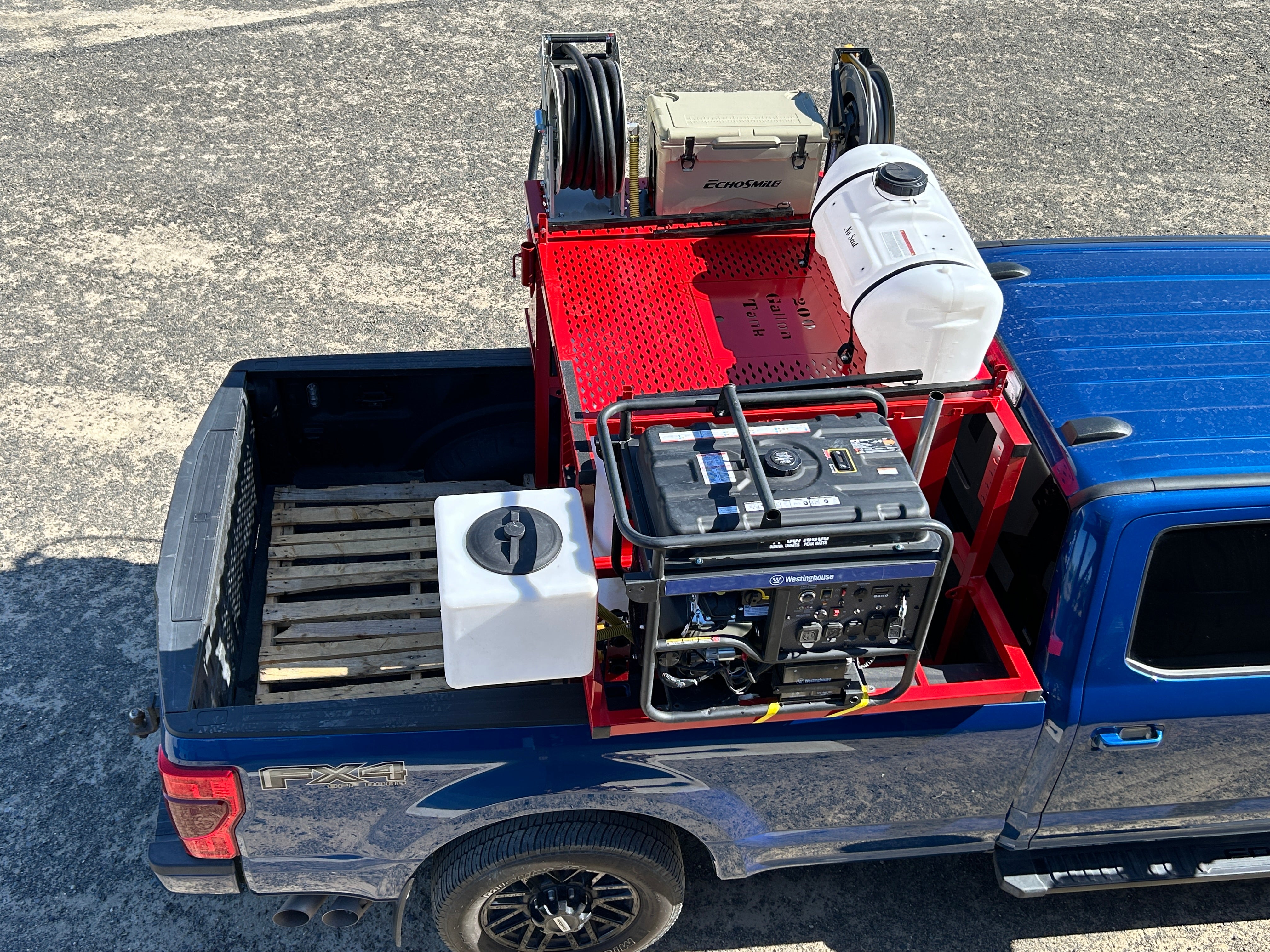
Best for: single-rig DJI or XAG operators with a full-size pickup. Skip if: you regularly move three or more drones and need the extra deck space.
Roade: The Long-Bed Unit for Larger Fleets
Fleet operators need more real estate, and the Roade delivers it. This is an 8-foot unit built for a full-size long bed, and we recommend a 1-ton truck to carry it properly.
The capacity climbs with the footprint: a 200-gallon tank with bottom sump, a 25-gallon freshwater tank, a 15-gallon cone tank, a 5.5 gpm fresh water pump, and a 59 gpm AMT chemical pump. The storage box is wired with remote-controlled outlets, and the umbrella and data link mounts keep your gear accessible. The cabinet locks, which matters when the truck sits overnight at a field edge.
One honest limitation: the Roade fits small to medium drones like the XAG 150, T50, and J100. A T100 will not fit in the cabinet. For the full specification on the long-bed platform, you can review the complete Roade unit specs.
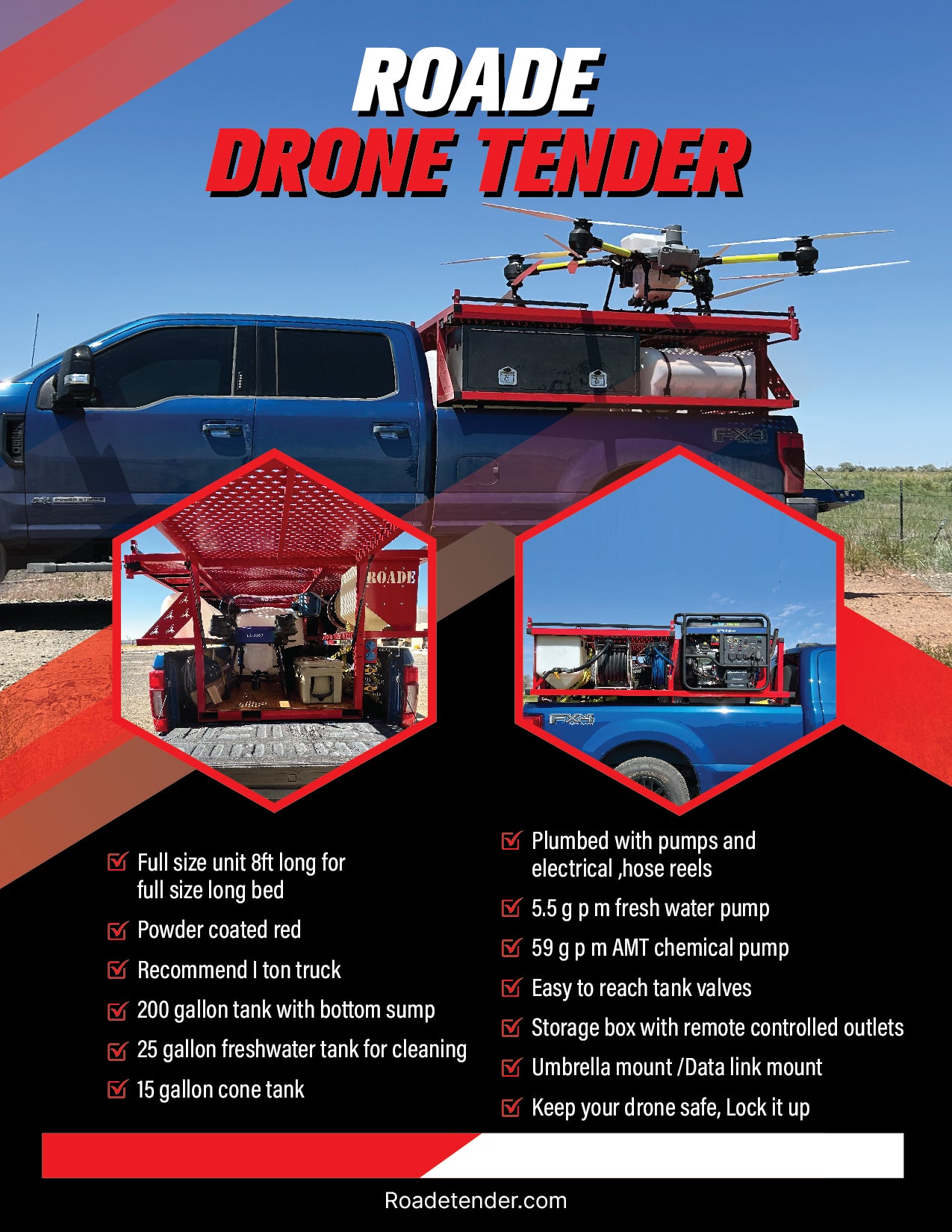
Best for: multi-drone fleets running small to medium airframes. Skip if: your fleet is built around T100-class aircraft.
Roade Tiny Trailer: An Agricultural Spray Drone Tender for Half-Ton Trucks
Not every operation has a 1-ton truck, and not every field has a road wide enough for one. The Roade Tiny Trailer solves both problems.
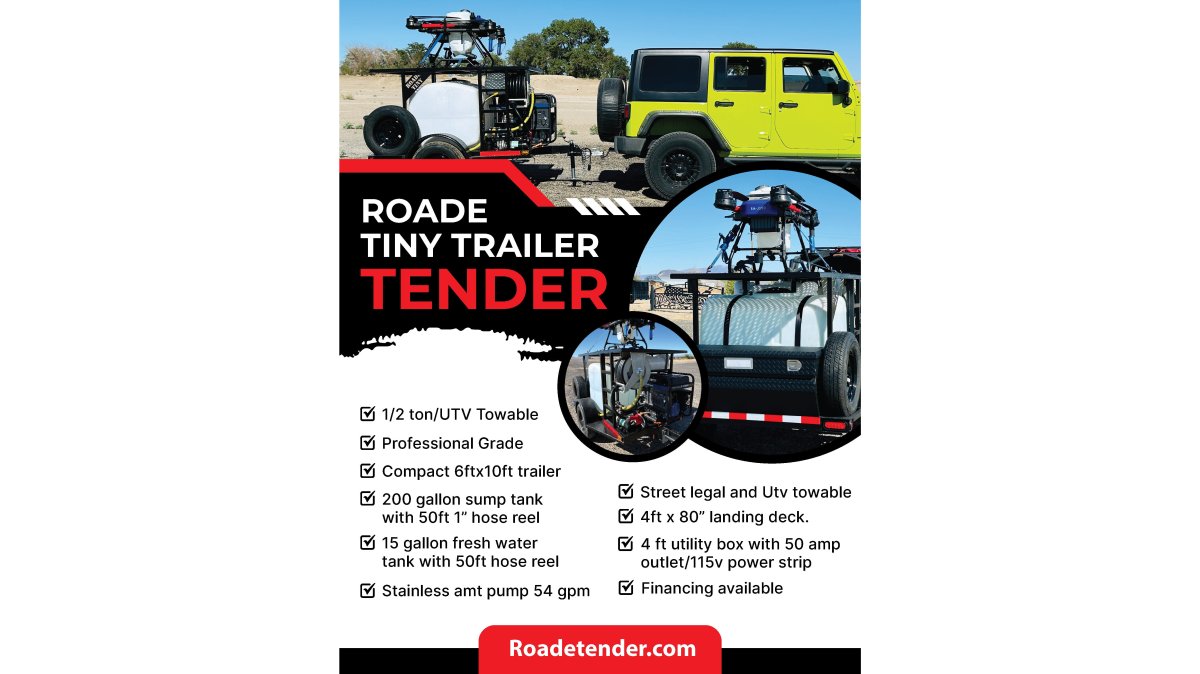
The trailer carries a 200-gallon tank with sump, a 15-gallon fresh water tank, a stainless AMT pump, and a four-nozzle spray mix recirculation system.
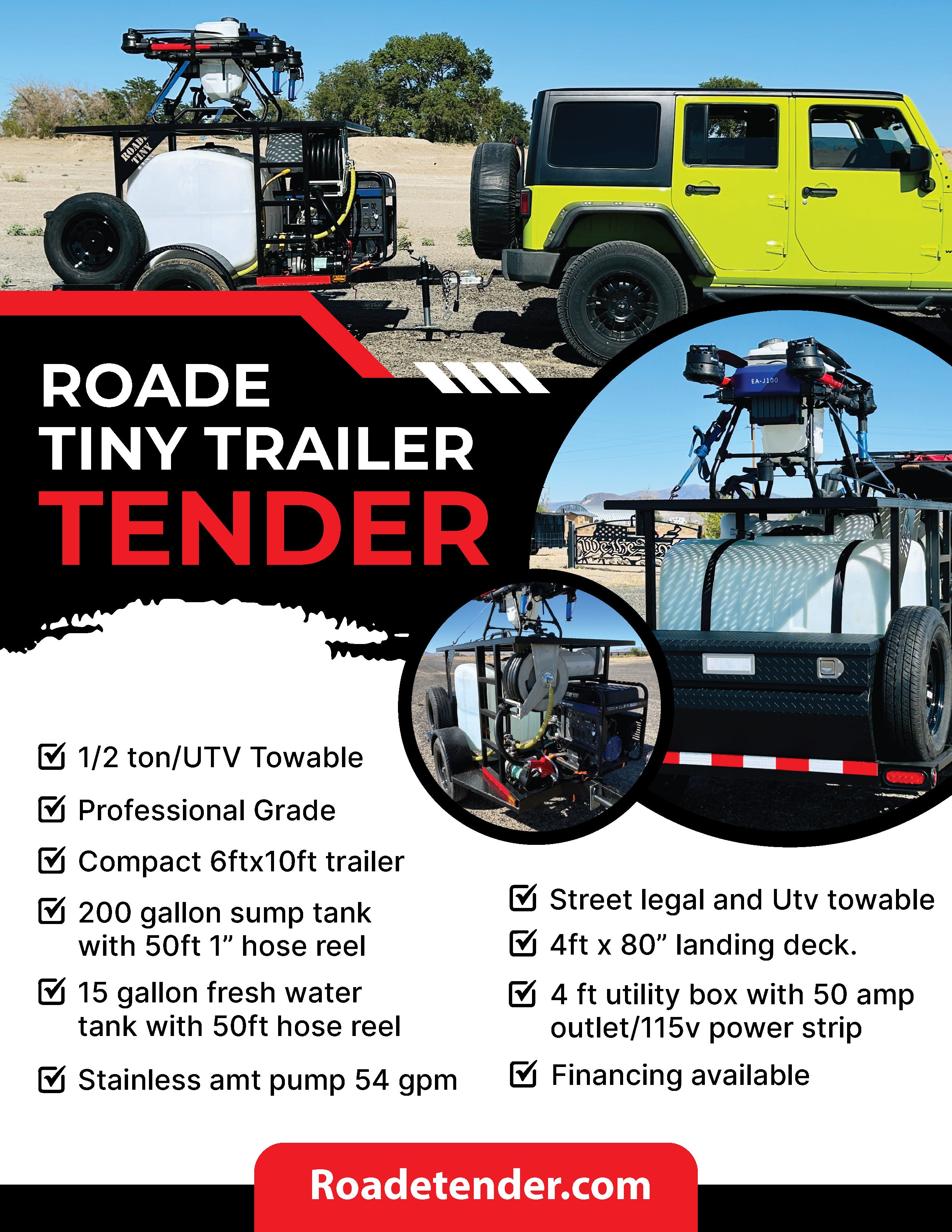
This is the unit for UTV-access jobs and operators who want to unhitch the support rig and leave the truck free. To confirm it works with your half-ton setup, you can check the Roade Tiny Trailer specifications.
Best for: half-ton truck and SUV owners, plus UTV-access fields. Skip if: you need maximum deck space for a large fleet.
Drone Tender Truck Setup: What Fits, What Weighs, What You Haul
A drone tender truck setup succeeds or fails on payload math. Before you buy anything, weigh your truck's payload rating against the tender, the generator, the full tank, and the drones.
Here is how we would plan the load:
- Tongue and bed weight: confirm the tender's dry weight (720 lbs for the JR, 920 lbs for the Tiny) against your truck's payload sticker.
- Generator placement: keep it in the wired storage box, not loose in the bed.
- Tank fill level: travel with a partial tank when road weight limits or fuel economy matter.
- Drone security: use a proper tie-down system rather than straps that crush the airframe.
Watch out: overloading a half-ton truck with a full tank, a generator, and three drones is the most common mistake we see. It strains the suspension and brakes, and it can put you over legal weight limits. Do the math first.
DIY Agricultural Drone Support Setup: What $4,500 Buys You
A DIY agricultural drone support setup is the right call for operators who already own a generator and want to build the rest themselves.
What you give up is the plumbing, pumps, hose reels, and electrical work that come pre-installed on a finished unit. You supply those, plus the labor.
To see exactly what ships in the box, you can view what the Roade JR DIY Kit includes.
Best for: operators with a generator, a shop, and mechanical skill. Skip if: you need a field-ready rig this season.
Total Cost of Ownership: Itemized Costs Before You Commit
The sticker price is only part of the number. Total cost of ownership for spray drone field support infrastructure includes the platform, the power source, the drone itself, installation and setup, connectivity, maintenance, software, training, and accessories. Here is how the line items stack up, using our range as the reference point and noting where third-party costs apply.
Purchase and platform costs
| Cost Item | What It Covers | Price |
|---|---|---|
| Roade JR | Finished tender, plumbed and wired | $10,500 |
| Roade | Long-bed tender for larger fleets | $12,500 |
| Roade Tiny Trailer | Towable tender for half-ton trucks | $10,500 |
| Roade JR DIY Kit | Frame and tanks, no generator | $4,500 |
| Drone tie-down system | Secures one drone in transit | $220 |
| DJI T100 base ready-to-fly kit | Drone, controller, 3 batteries, charger, tool kit | $41,500 |
Two things stand out. First, the tender is a fraction of the total outlay once you factor in the aircraft: a $41,500 ready-to-fly T100 kit dwarfs a $10,500 tender. Second, the accessories are cheap relative to the risk they remove. A $220 tie-down that keeps a drone from sliding into a tank wall pays for itself the first time it prevents damage.
Lifecycle costs buyers often miss
The purchase price is the easy part. Budget for these line items before you commit:
- Generator: not included on finished units or the DIY kit. A generator sized to your battery count is a separate purchase; confirm fuel type, runtime, and whether it fits the wired storage box.
- Installation and setup: mounting, plumbing checks, and electrical verification. A finished tender ships plumbed and wired, but you still need to confirm fit to your truck and test the pump and outlets before the season.
- Connectivity: cellular data plans for fleet-management or dock software, plus any data-link hardware. Spray tenders often need only a phone or tablet link; docks need a reliable local network and a permanent power drop.
- Maintenance: pump seals, hose reels, tank rinsing, powder-coat touch-up, and generator service. Stainless pumps and powder-coated frames reduce but do not eliminate upkeep.
- Software: fleet-management, record-keeping, and compliance logging subscriptions if you use them. Confirm whether the unit's charging and status data can feed your software.
- Training: operator time to learn the mix, rinse, and charge workflow, plus any safety and compliance training your operation requires.
- Insurance and registration: trailers need registration and may need separate coverage; truck-bed units ride on the truck's policy but change its payload and liability profile.
A common pattern is that the tender and tie-downs are a small share of first-year spend, while generator, connectivity, and training are the line items that surprise buyers.
Procurement checklist and vendor evaluation criteria
Before you sign, run this checklist against any field support infrastructure purchase:
- Requirements fit: tank capacity, pump flow rate, rinse capacity, charging capacity, and deck size matched to your aircraft and daily acreage.
- Interoperability: built for your airframe family (DJI, XAG, and similar), compatible with your battery chargers, and able to feed your fleet-management or data system if needed.
- Support and warranties: written warranty terms, spare-parts availability, and a named service contact. Ask how long a pump or reel replacement takes.
- Service-level commitments: response time for repairs, whether service is remote or on-site, and what happens mid-season if a unit fails.
- Security: for networked docks or software, confirm cybersecurity expectations and who owns the data.
- Compliance: verify applicable aviation rules for commercial operations and any procurement requirements if the purchase runs through a public agency or grant program. Requirements vary, so confirm with your aviation counsel or procurement office.
- Total cost: compare not just sticker price but generator, connectivity, maintenance, software, and training across vendors.
Watch out: a low sticker price with no spare-parts path or service commitment can cost more over a season than a higher-priced unit with a named service contact. Price the support, not just the platform.
Our advice: budget the tender, generator, tie-downs, and first-year connectivity and training into the same purchase as the drone. That is the number that actually decides whether the infrastructure pays for itself in acres sprayed.
Choose Your Tender Setup Before the Season Starts
Our recommendation is straightforward. Single-rig DJI or XAG operators should start with the Roade JR. Fleet operations running small to medium airframes should step up to the long-bed Roade. Anyone limited to a half-ton truck or working UTV-access fields should look at the Roade Tiny Trailer.
The hardest part of scaling a spraying operation is not buying the drone. It is building ground support that keeps it flying. Roade Tender manufactures custom spray drone tenders for DJI, EA Vision, and XAG systems, with ready-to-fly kits and DIY options so your equipment stays field-ready.
Frequently Asked Questions
What equipment do you need to support agricultural spray drone operations in the field?
At minimum you need a chemical mixing and refill system, a freshwater rinse tank, a power source for battery charging, and a stable landing area. Roade Tender units bundle these: the Roade JR carries a 200-gallon tank with sump, a 25-gallon freshwater tank, a 54 gpm stainless chemical pump, and a 5.5 gpm freshwater pump. A generator is not included on the base JR, so budget for one if you need charging power in the field.
Is a ready-to-fly drone support kit better than a DIY setup?
It depends on how much assembly and sourcing you want to handle. The Roade JR DIY Kit at $4,500 includes the powder-coated frame, 200-gallon sump tank, and 25-gallon rinse tank, but no generator. A complete Roade JR at $10,500 arrives plumbed with pumps, electrical, and hose reels. If your time in-season is worth more than the price gap, the complete unit wins; if you already own pumps and a generator, the kit is the cheaper path.
How do you choose a tender for DJI, EA Vision, or XAG drones?
Start with drone size and your truck. The Roade fits small to medium drones including the XAG 150, T50, and J100, but the T100 will not fit in its cabinet. The Roade JR mounts on a full-size pickup; the Roade Tiny trailer suits half-ton trucks, SUVs, and UTV work, and is street legal under 3,000 lbs loaded. Match the tank and pump capacity to how many acres you cover per fill cycle.
How can operators reduce downtime during agricultural drone spraying?
Cut the manual steps between flights. A tender with an on-board chemical pump, freshwater rinse, and reachable tank valves lets you refill and clean without hauling jugs or a separate mixing station. Remote-controlled outlets in the storage box let you run charging equipment without climbing into the bed. A drone tie-down system is available as an accessory.
