
The DJI Drone Field Support Equipment Guide
Last Updated: November 19, 2026
Quick Summary
Field support equipment is the ground infrastructure that keeps a DJI Agras spraying instead of sitting idle: power, water, chemistry, transport, and spares organized so one crew can cycle drones without stopping. Build it as a single integrated station where a drone can land, swap batteries, refill, and launch again.
- A complete checklist covers four categories: liquid handling, power, tools and data, and transport.
- Size the mix tank at least 2x the aircraft spray tank and fresh water at least 10% of mix volume.
- Size the generator to run all chargers at once plus a 20% margin.
- The Roade Tiny trailer suits half-ton trucks and SUVs and weighs under 3,000 lbs fully loaded.
- Lay the station out in a U so the crew stays within arm's reach from landing to relaunch.
Table of Contents
- What Field Support Equipment Actually Keeps a DJI Agras Flying
- The Drone Spraying Field Equipment Checklist
- Building a DJI Agras Field Support Setup
- Agricultural Drone Battery Charging Setup That Keeps Up
- Choosing an Ag Spray Drone Trailer for Your Fleet
- Transport and Storage Logistics Between Fields
- Safety Protocols and Risk Mitigation on Site
- Ergonomic Field Station Design and Environmental Resilience
- Inventory, Maintenance and Technical Support Planning
- Matching a Tender to Your Operation Before the Season Starts
- Frequently Asked Questions
What Field Support Equipment Actually Keeps a DJI Agras Flying
Field support equipment is the ground infrastructure that keeps a DJI Agras spraying rather than sitting idle: power, water, chemistry, transport, and spares, organized so a single crew can cycle drones without stopping. At Roade Tender, we build the tenders that carry it. That order is backwards.
The math is unforgiving. Every minute an Agras sits on the ground waiting for a battery swap or a refill is a minute of lost application window. A common mistake is treating support gear as an afterthought, a pickup bed full of loose jugs and a generator in the dirt. The operators who cover the most acres per day are the ones who treat the ground operation as its own system.
Below, we break down exactly what that system needs, from the checklist to the trailer, so you can spec it once and stop rebuilding it every morning.
The Drone Spraying Field Equipment Checklist
A complete drone spraying field equipment checklist covers four categories: liquid handling, power, tools and data, and transport. Miss any one and the whole cycle slows down. Use this as your baseline before you add anything optional, and size each line item to your actual spray cycle rather than to what fits in the truck.
| Category | Core Items | Sizing Rule of Thumb | Why It Matters |
|---|---|---|---|
| Water and chemical | Mix tank with sump, fresh water tank, transfer pump, hose reels, measuring gear | Mix tank at least 2x the aircraft spray tank; fresh water at least 10% of mix volume for rinse-down | Refills and rinse-downs without leaving the field |
| Power | Generator, charging station, power distribution panel, spare batteries | Generator sized to run all chargers at once plus a 20% margin | Keeps aircraft cycling instead of waiting |
| Tools and data | Spare nozzles, hand tools, tablet, telemetry link, spare props | One full spare set of nozzles and props per aircraft | Fast field fixes and clean records |
| Transport | Tender or trailer, tie-downs, storage boxes, spill kit | Trailer rated for loaded weight plus tongue weight on your truck | Moves the whole station between fields |
Water, Chemical and Mixing Gear
Liquid handling is where most downtime hides. Keep hoses on reels so they don't become a trip hazard or a knot.
That buffer lets the crew refill the aircraft twice before touching the tender, which is the difference between a smooth cycle and a queue at the pump.
Label every tank and every hose end so there is no ambiguity at the mix point, and keep a dedicated measuring pitcher and a rinse station at the fill point.
Power and Battery Cycling Gear
Count your chargers, multiply by their input wattage, and add a margin. A power distribution panel with labeled, remote outlets means nobody crawls under equipment to plug in a pack.
Keep charged and depleted batteries physically separated, ideally in different colored cases, so nobody grabs the wrong pack in a hurry.
Tools, Spares and Data Gear
Carry spare nozzles, a basic tool kit, and a charged tablet with your flight planning app loaded. Firmware updates and calibration should happen before the field, not in it. A rugged storage box that keeps tools dry and organized saves more time than any single gadget.
A simple minimum-level list taped inside the storage box lid tells the crew what to restock before the next field day, and it prevents the mid-field realization that the spare nozzles are back at the shop.
Transport and Tie-Down Gear
Transport gear is part of the checklist, not an afterthought. A tender or trailer rated for the loaded weight, tie-downs that secure the aircraft without crushing the frame, and labeled storage boxes for spares and data gear turn a move between fields into a five-minute job. A spill kit belongs on the trailer too, because chemistry handling without one is a risk you don't need to carry.
Building a DJI Agras Field Support Setup
A DJI Agras field support setup works best when it's built as one integrated station rather than a collection of parts. The goal is a single parked unit where a drone can land, swap batteries, refill, and launch again without the crew walking back to a truck.
Set it up in this order:
- Park the tender or trailer at the field edge with clear approach and departure lanes.
- Level the unit and set the landing deck.
- Stage charged batteries and the charging station within arm's reach of the deck.
- Run chemical and fresh water reels to the fill point.
- Confirm telemetry link and tablet before the first launch.
Expected result: a full cycle from landing to relaunch that a two-person crew can run without leaving the station.
Agricultural Drone Battery Charging Setup That Keeps Up
An agricultural drone battery charging setup is the single biggest lever on daily flight time. If your charging capacity can't keep pace with your spray cycles, the aircraft waits, and the crew waits with it. Plan power around your cycle time, not around what fits in the truck.
The practical approach is a generator sized to run multiple chargers at once, with a power distribution panel and remote outlets so you're not crawling under equipment to plug in. Keep charged and depleted batteries physically separated so nobody grabs the wrong pack. Watch out: charging in direct sun or in a closed box shortens battery life and slows the charge, so shade the station and keep airflow moving.
Choosing an Ag Spray Drone Trailer for Your Fleet
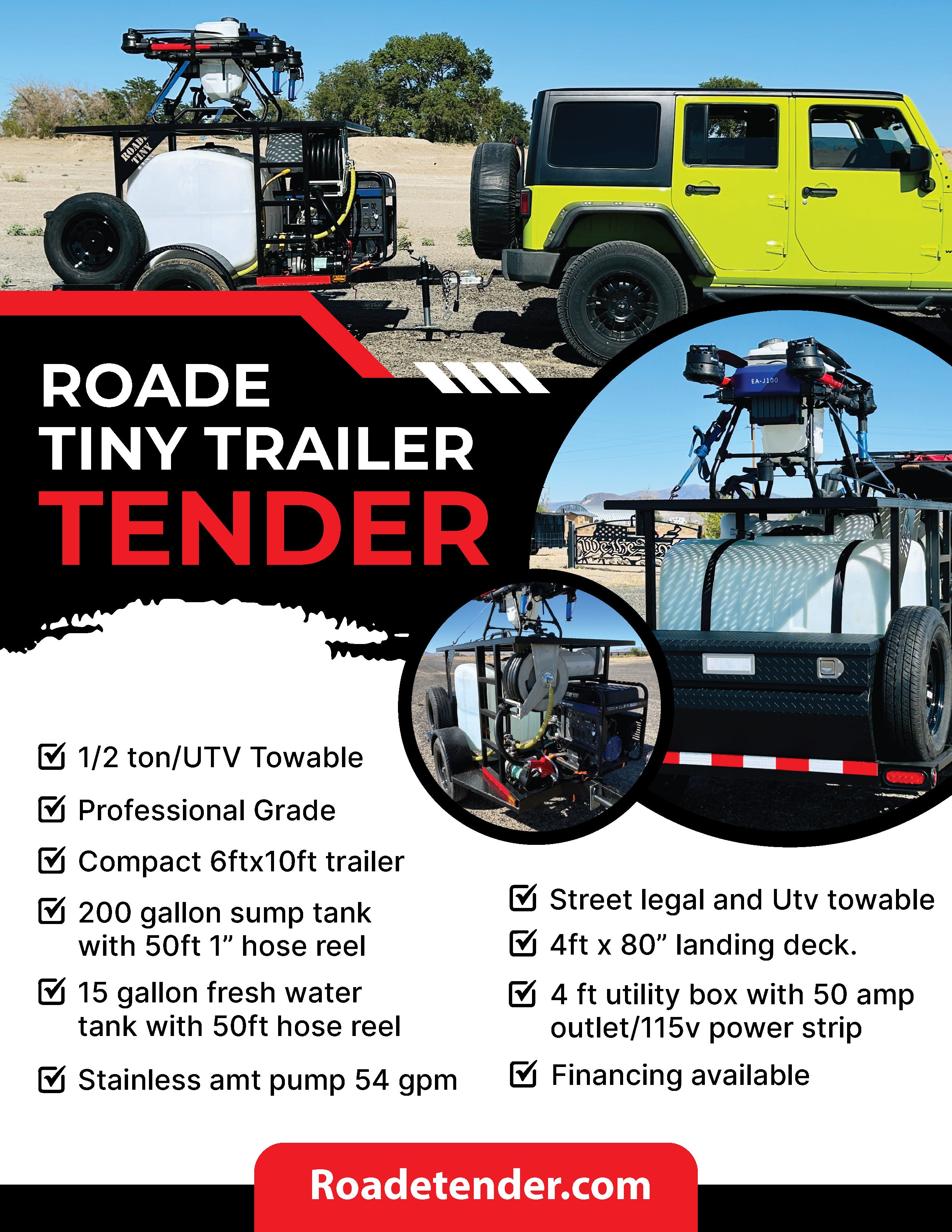
An ag spray drone trailer is the foundation the rest of the support equipment mounts to. Pick the trailer first and the checklist gets easier, because tank, pump, reels, and power all have a home. We build ours around that idea, with a tank sump, fresh water supply, hose reels, and a plumbed storage box for power.
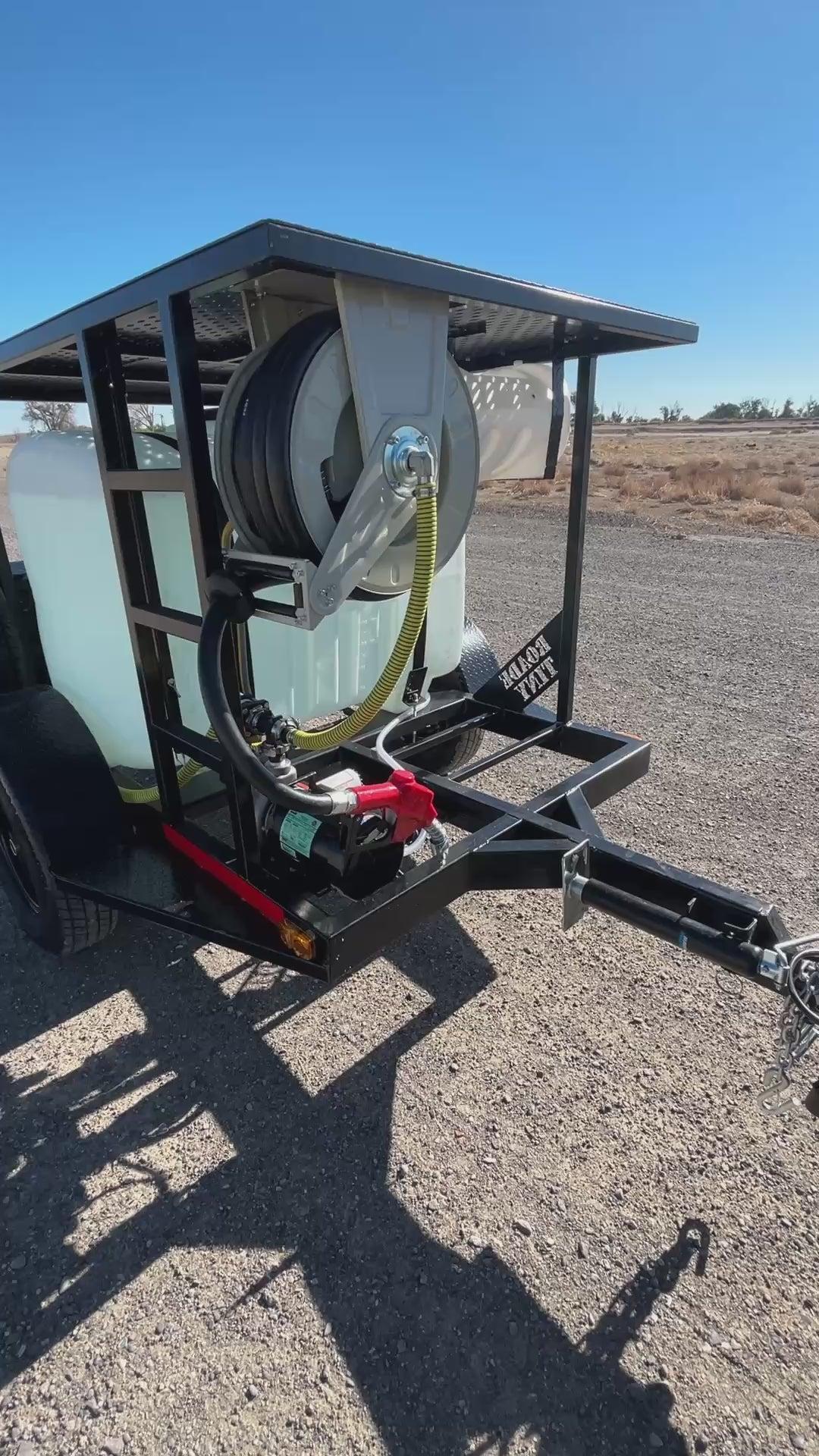
Match the trailer to your truck and your fields before anything else:
- Roade Tiny trailer suits half-ton trucks and SUVs, weighs under 3,000 lbs fully loaded. It carries a 200-gallon tank with sump, a 15-gallon fresh water tank, a stainless AMT pump, and a 4ft x 80 landing deck. Priced at $10,500.00. See the Roade Tiny trailer
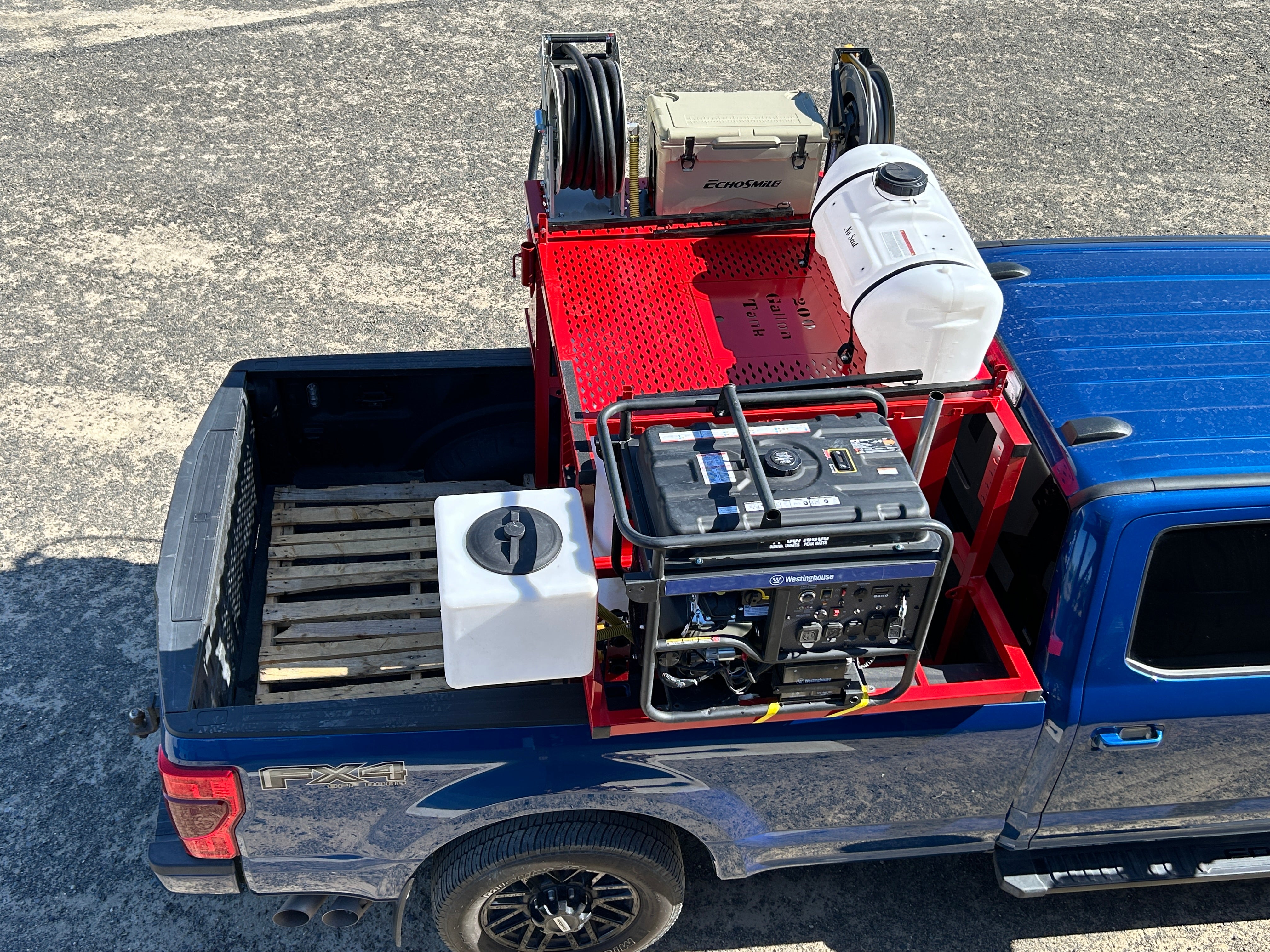
- Roade JR is made for a full-size pickup, weighs 720 lbs without a generator, and includes a 200-gallon tank with bottom sump, a 25-gallon fresh water tank, a 5.5 gpm fresh water pump, and a 54 gpm AMT stainless chemical pump. Priced at $10,500.00. Check the Roade JR specs
- Full tender range for DJI, EA Vision, and XAG systems, in ready-to-fly or DIY form. Browse the full tender collection
Secure the aircraft in transit with a proper drone tie-down system rather than straps that crush the frame. **
Transport and Storage Logistics Between Fields
Transport and storage logistics decide whether moving between fields is a five-minute job or a daily ordeal. Everything should have a fixed mount, a labeled spot, and a lid. Loose gear becomes damage in transit and lost time on arrival.
A simple clipboard or app-based list of what's loaded prevents the mid-field realization that the spare nozzles are back at the shop.
Safety Protocols and Risk Mitigation on Site
Safety protocols and risk mitigation on site start with a pre-flight checklist and a written risk assessment for each field. Chemistry handling, battery thermal risk, and rotor proximity are the three hazards that cause the most incidents, and all three are manageable with routine.
Require gloves, eye protection, and a rinse station at the mix point. Keep a fire extinguisher rated for lithium battery fires on the tender. Establish a no-fly buffer near people and property, and log every flight for regulatory compliance. For tactics that cut downtime without cutting corners, read how to cut spray drone downtime at the field.
Ergonomic Field Station Design and Environmental Resilience
Ergonomic field station design is the angle most operators ignore until their crew is exhausted by midseason. Reach matters. Tank valves, generator controls, and hose reels should all be accessible without climbing or crawling, which is exactly why we plumb controls to easy-reach positions on the Roade JR.
Design the station around a single standing position. The operator should be able to reach the landing deck, the battery charging station, the fill point, and the tablet without taking more than a step or two. A common pattern is to lay the station out in a U: landing deck at the open end, charging station on one side, fill point on the other, and the tablet and controls at the base of the U. That layout keeps the crew inside arm's reach of everything that happens between landing and relaunch.
Height matters as much as distance. Controls and valves at waist height reduce bending and lifting over a long day. Hose reels mounted at chest height let the crew pull and retract without stooping. Keep the walking surface between the deck and the fill point clear and level, because a trip hazard at the busiest point in the cycle is a safety problem and a time problem at once.
Environmental resilience gear covers the rest: shade for the charging station, covers for electronics, and dust protection for the generator. Wind, heat, and grit are constant in ag work. A station built for a parking lot will fail in a field.
Dust protection extends to the data gear. A tablet in an open tray collects grit that works into the ports and the screen edge. A sealed case with a screen cover costs little and prevents the mid-season failure that ends a field day early. Keep spare covers and filters on the trailer so a torn cover doesn't become a reason to stop.
Inventory, Maintenance and Technical Support Planning
Inventory, maintenance, and technical support planning keeps the whole system running across a season. Set a maintenance schedule for pumps, reels, and the generator, and track it. Firmware updates and calibration belong on that schedule too.
Keep a running spare parts inventory with minimum levels, and know your support path before something breaks. Watch out: discovering a pump seal is unavailable mid-season is a planning failure, not bad luck. Stock the wear items you know will fail.
Matching a Tender to Your Operation Before the Season Starts
Matching a tender to your operation comes down to three questions: how many drones, what truck, and what access. Answer those and the spec writes itself. A single-drone operation on a half-ton truck needs a different unit than a four-drone fleet on full-size pickups.
If you're weighing a full ready-to-fly kit against a DIY build, the trade-off is assembly time versus upfront cost. We offer both ready-to-fly and DIY options. When you're ready to talk through a custom build, contact us for a quote and we'll match the tender to your fleet before the season starts.
The operators who win the season aren't the ones with the newest aircraft. They're the ones whose ground operation never stalls. Roade Tender builds custom spray drone tenders for DJI, EA Vision, and XAG systems, with ready-to-fly and DIY options, plumbed tanks and pumps, and power-ready storage boxes so your crew spends its day flying instead of fixing. Get started with Roade Tender and build a field support station that keeps every drone working.
Frequently Asked Questions
What equipment do you need to support a DJI Agras drone in the field?
At minimum you need a water source and mixing setup, a generator or power supply for battery charging, spare batteries and props, a calibrated spray system, and a transport vehicle that secures the aircraft. A field support equipment setup built around a tender adds a 200-gallon tank, chemical and fresh water reels, pumps, and a landing deck so refills and battery swaps happen in one stop. Add a pre-flight checklist, telemetry device, and spare parts inventory to cover a full spray day.
How do you power and charge DJI Agras batteries in the field?
Most operators run a generator paired with the manufacturer's charging hub, then rotate packs so charging happens while the drone flies. An agricultural drone battery charging setup needs enough output to charge two to four packs at once, a power strip with remote outlets, and a shaded, ventilated spot away from chemical mixing. Plan charging around your spray window: a pack that finishes mid-tank is wasted capacity, so stagger charge starts to match refill timing.
How much water and battery capacity should a drone spraying operation carry?
Size capacity to your spray window, not to a full day. A 200-gallon tank on a tender covers multiple refills for typical Agras payloads before you need a resupply run, and 25 gallons of fresh water handles cleanup and mixing dilution. For batteries, carry at least two packs per aircraft in rotation plus one spare. Operators running three or four drones should plan charging capacity for the whole fleet, not one machine at a time.
What spare parts and tools should agricultural drone operators bring?
Carry spare props, nozzles, filters, pump seals, hose clamps, and a full set of hex and torque tools. Add a multimeter, spare fuses, zip ties, and a tablet or controller with charged backup power. Keep a spare parts inventory log so you reorder before a part runs out mid-season. A tie-down system for the aircraft during transport prevents the most common damage: props and arms shifting on rough field roads.
How do you choose a tender for a DJI agricultural spraying drone?
Match the tender to your truck, your drone model, and your daily spray volume. A full-size pickup can carry a unit like the Roade JR at $10,500, which includes a 200-gallon tank, 25-gallon fresh water tank, pumps, hose reels, and a 48-inch landing platform. Smaller trucks and UTVs suit the Roade Tiny at $10,500, which weighs under 3,000 lbs loaded and stays street legal. Confirm tank fittings, deck height, and generator mounting before you buy.
What should operators check before starting a DJI Agras field operation?
Run a pre-flight checklist: firmware updates, compass calibration, spray system pressure test, nozzle pattern check, and battery state of charge on every pack. Confirm the tank is filled to the planned mix, ground control points are set for survey-grade mapping, and the flight plan accounts for wind and signal interference. Check that tie-downs are removed, the landing deck is clear, and chemical handling gear is within reach before the first takeoff.
