
Can You Cut Spray Drone Downtime at the Field?
Last Updated: November 14, 2026
Quick Summary
Optimizing field workflow for a spray drone starts with the ground stop, not the flight, because refill and battery swap time is the variable you control. Plan a refill station before the first flight, run a three-pack battery rotation with parallel charging, and pre-stage the next mix during flight. Cutting ground stop time from 5 to 3 minutes lifts output from 32 to roughly 37 acres per hour.
- Place the refill point at a corner or mid-edge position, not the gate you drove in through.
- Keep at least three battery packs per drone in active service and charge them in parallel.
- A three-person crew splits pilot, tender operator, and field coordinator roles before the truck leaves the yard.
- Acres per hour equals acres per tank divided by flight time plus ground stop time, times 60.
- Set a hard wind cutoff from the product label and check it at the refill point, not just at launch.
Table of Contents
- Build the Workflow Around the Refill, Not the Flight
- Step 1: Plan a Spray Drone Field Refill Station Before the First Flight
- Step 2: Set Up Spray Drone Battery Management for a Full Day
- Step 3: Calibrate Spray Parameters Before You Cover an Acre
- Step 4: Assign Crew Roles and Coordinate Ground Operations
- Step 5: Weather and Drift Decision Thresholds
- Drone Spraying Productivity per Acre: Plan Your Daily Throughput
- Agricultural Drone Spraying Safety Checklist for Every Field
- Frequently Asked Questions
Build the Workflow Around the Refill, Not the Flight
Most operators plan a spray day around flight time. That is the wrong anchor.
A spray drone is a spray drone: an unmanned aircraft fitted with a tank, pump, and nozzles that applies crop protection products over a field.
Roade Tender builds tenders for operators running DJI, EA Vision, and XAG systems.
Below, we break down a five-step workflow, from refill station planning to drift thresholds, so you can plan throughput instead of hoping for it.
Step 1: Plan a Spray Drone Field Refill Station Before the First Flight
A spray drone field refill station is a fixed or mobile point where the drone lands, refills its tank, swaps batteries, and returns to work. Plan it before the first flight, not after the first empty tank.
Get this wrong and every subsequent stop costs you. Get it right and the rest of the workflow runs on rails.
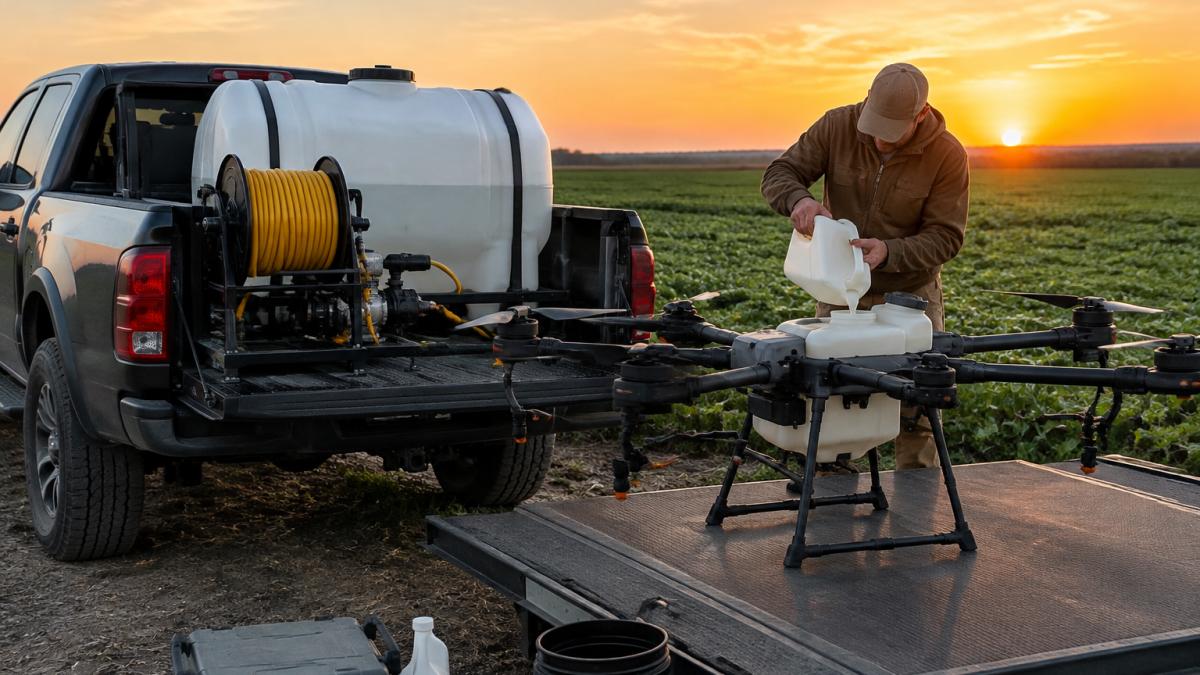
What Goes on the Tender
A working tender carries more than a tank. At minimum, you need:
- A chemical tank sized to your spray volume
- A freshwater tank for rinsing and cleaning
- A transfer pump rated for your mix
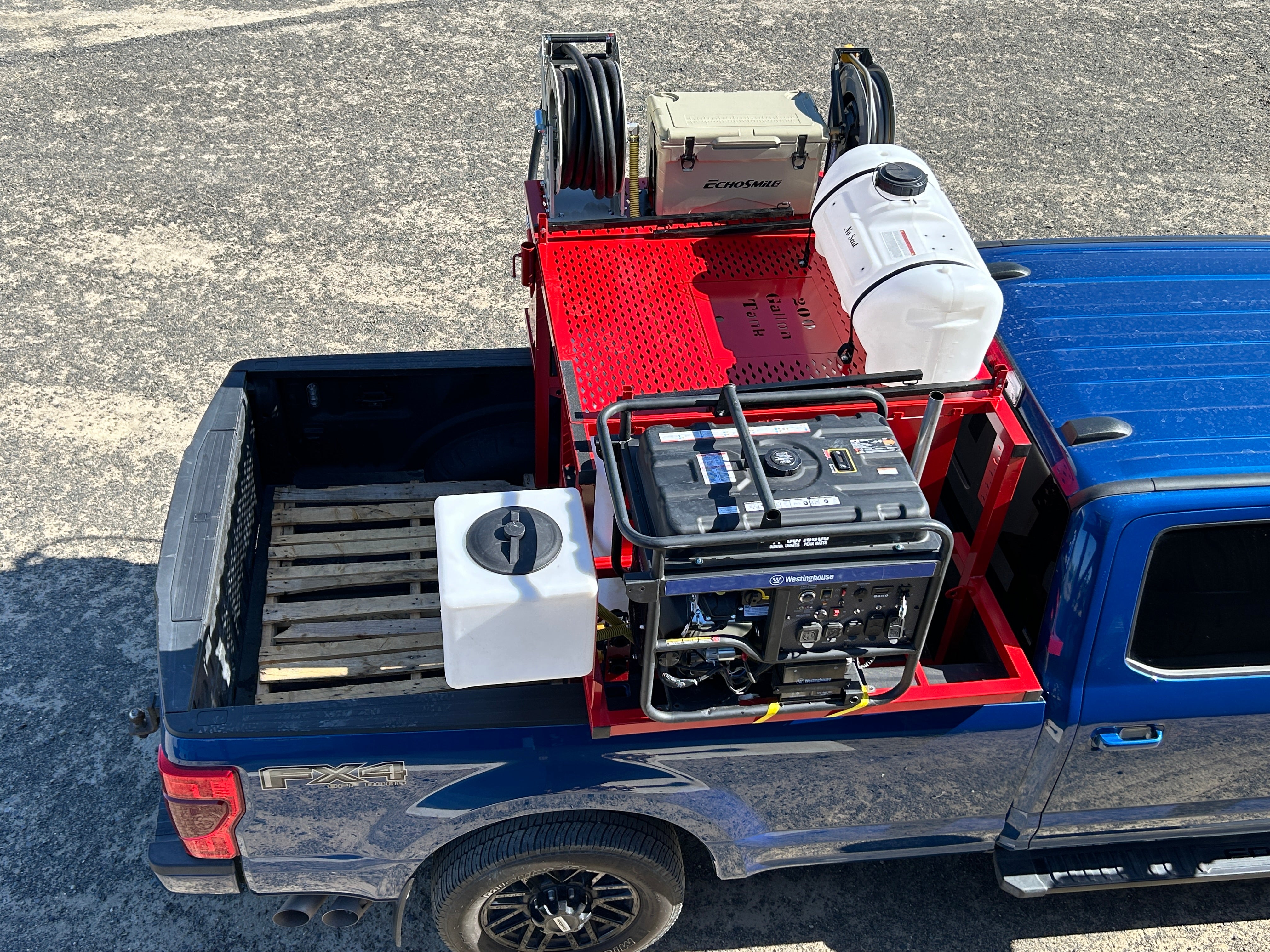
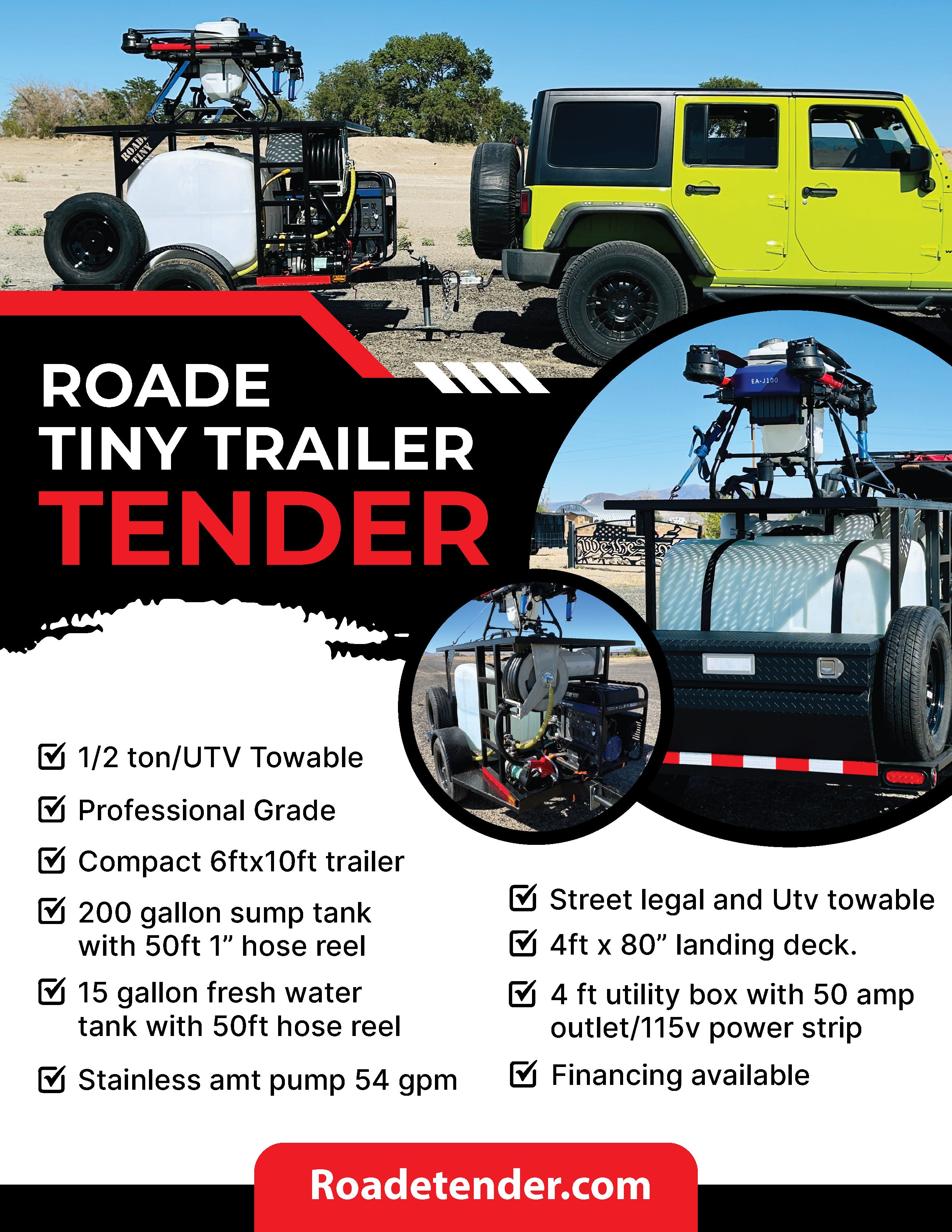
Our Roade JR is built for a full-size pickup bed and pairs a 200-gallon tank with a 25-gallon freshwater tank, a 54 gpm stainless chemical pump, and a 5.5 gpm freshwater pump. If you move between tight fields, the Roade Tiny trailer fits a half-ton truck or SUV and stays street legal.
Refill Point Placement and Field Layout
Place the refill point where the drone spends the least time flying back to it. In a rectangular field, that is usually a corner or a mid-edge position, not the gate you drove in through.
Map your flight paths before you place the tender. Then check:
- Distance from refill point to the farthest spray line
- Room to land and take off without crossing the tender
- Wind direction relative to the mixing area
If you are weighing transport setups, our comparison of XAG drone transport solutions covers the trade-offs between truck-bed and trailer configurations.
Step 2: Set Up Spray Drone Battery Management for a Full Day
Spray drone battery management is the practice of rotating, charging, and tracking packs so a charged battery is always waiting when the drone lands.
The mistake we see most is charging one pack at a time.
Build a rotation instead:
- Keep at least three packs per drone in active service
- Charge in parallel, not in sequence
- Track cycle counts so weak packs get retired before they fail mid-season
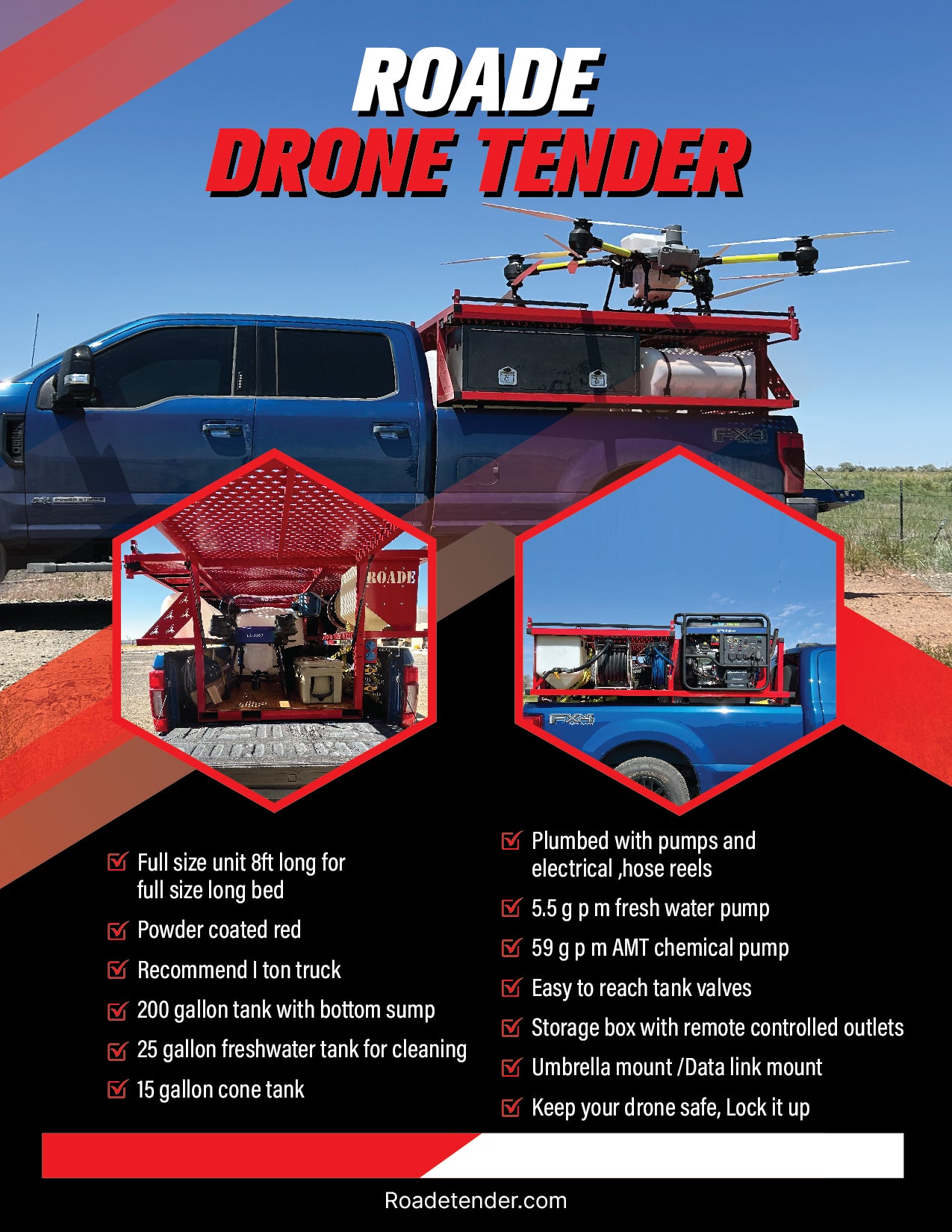
A full-size tender like the Roade carries a 200-gallon tank and a storage box with remote-controlled outlets, which lets you run chargers and pumps from one power point.
Step 3: Calibrate Spray Parameters Before You Cover an Acre
Calibration is the process of matching flight speed, altitude, droplet size, and application rate to the product label and crop. Skip it and you either over-apply or under-apply, both of which cost money.
Flight Speed, Altitude, and Droplet Size
Faster flight and higher altitude spread droplets thinner. Slower flight and lower altitude put more product on target but slow your acreage per hour.
Set these against the label, then confirm with water-sensitive paper. Droplet size matters most for drift-prone products. Coarse droplets drift less; fine droplets penetrate canopy better but move with wind.
Swath Width and Spray Coverage Checks
Swath width is the width of ground one pass covers. Set it too wide and you get streaks. Set it too narrow and you waste passes.
Check coverage with water-sensitive paper at the start of each field and after any nozzle change. Uniform coverage across the swath is the goal, not just total volume.
Step 4: Assign Crew Roles and Coordinate Ground Operations
Ground operation coordination is the difference between a smooth day and a chaotic one. Assign roles before the truck leaves the yard, and write them down.
A practical three-person setup:
- Pilot: flies, monitors the drone, calls the landing, and owns the airspace decision
- Tender operator (mixer-loader): mixes, refills, swaps batteries, and manages the chemical and freshwater supply
- Field coordinator (spotter): watches for drift, obstacles, and bystanders, and manages the refill-point staging and vehicle access
On a two-person crew, the pilot and tender operator split the coordinator duties. Never let mixing and flying happen without someone watching the airspace.
The Timed Ground-Stop Handoff
The value of assigned roles shows up in the seconds between landing and the next takeoff. A repeatable handoff looks like this:
- Pilot calls the landing on the radio or hand signal at least 30 seconds out, so the tender operator is at the pad with the hose and a charged pack before touchdown.
- Tender operator takes the pack as the pilot lifts the empty tank lid, and hands back a charged pack in the same motion. Battery swap and tank fill happen in parallel, not in sequence.
- Field coordinator confirms the mix against the batch record and checks wind at the pad, not just at launch, before the pilot lifts off.
- Pilot confirms tank level, pack charge, and geofence on the controller, then calls the takeoff.
Over a 40-stop day, that is the difference between finishing the field and finishing it tomorrow.
Communication and Handoff Rules
- Use one shared radio channel or a hands-free headset for the pilot and tender operator; hand signals alone break down when the drone is loud and the wind is up.
- Agree on a single word for "abort the takeoff" and a single word for "stop spraying now." Everyone on the crew uses the same words every time.
- The pilot never leaves the controller to help mix. If the crew is short-handed, the field coordinator mixes and the pilot stays on the sticks.
Watch out: on a two-person crew, the temptation is to let the pilot mix while the drone is airborne. That works until a clog or a wind shift needs an immediate response, and the pilot is elbow-deep in concentrate. Keep the pilot's hands free and let the ground work wait for the landing.
Who Owns What When Something Goes Wrong
Assign a single owner for each failure mode before the season starts, so nobody debates it in the field:
- Nozzle clog or uneven pattern: tender operator stops the fill, the pilot lands, and the field coordinator checks coverage paper before the next pass.
- Battery fault or low cycle life: tender operator quarantines the pack and logs the cycle count; the pilot does not fly a pack that has been flagged.
- Wind shift or drift call: field coordinator calls it, pilot lands, and the decision is logged with the time and wind reading.
Write these owners on a laminated card taped inside the tender lid. The card is faster than a phone call and works when the radio battery dies.
Step 5: Weather and Drift Decision Thresholds
Set your weather thresholds in writing before the season starts.
Establish a hard wind cutoff based on the product label and your drone's limits. Check it at the refill point, not just at launch.
Spray drift is the movement of product off target. It wastes chemical, damages neighboring crops, and creates liability. The label is your authority here, and so is the EPA guidance on pesticide drift.
Drone Spraying Productivity per Acre: Plan Your Daily Throughput
Drone spraying productivity per acre depends on three numbers: flight time per tank, ground stop time, and tank volume. Improve any one and daily acreage climbs. Here is the arithmetic that turns it into a plan.
The Throughput Formula
Acreage per hour is set by the cycle, not the flight:
Acres per hour = (acres covered per tank) ÷ (flight time per tank + ground stop time) × 60
Worked example with round planning numbers: a drone that covers 8 acres per tank, flies 10 minutes per tank, and spends 5 minutes on the ground per stop produces 8 ÷ (10 + 5) × 60 = 32 acres per hour. Cut the ground stop from 5 minutes to 3 and the same drone produces 8 ÷ 13 × 60 ≈ 37 acres per hour, a gain of roughly 15% with no change to the aircraft.
That is the whole argument for optimizing the ground stop: it is the only variable in the formula you fully control.
Model the Refill Cycle, Not the Flight
Build a refill-cycle model for your own operation before the season. Measure these five numbers for one full day and write them down:
| Variable | What to Measure | Typical Lever |
|---|---|---|
| Flight time per tank | Minutes from takeoff to empty | Match speed and rate to the label |
| Ground stop time | Minutes from landing to next takeoff | Pre-stage mix and charged packs |
| Acres per tank | Tank volume ÷ label rate per acre | Size the tender to the field |
| Swath width | Feet per pass, verified on water-sensitive paper | Calibrate and re-verify after nozzle changes |
| Refill distance | Feet from tender to the farthest spray line | Reposition the tender mid-field |
Track these for a week and you will see exactly where your day leaks. The leak is usually the ground stop, and the second most common leak is refill distance on large or irregular fields.
Set KPI Targets for the Crew
Throughput planning only works if the crew has numbers to hit. Set targets at the start of the season and review them weekly:
- Ground stop time: target a consistent ceiling, and treat any stop over the ceiling as a process problem to fix, not a one-off.
- Stops per hour: a derived KPI that falls straight out of the cycle model; it makes the ground crew's performance visible without blaming the pilot.
- Acres per flight hour: separates aircraft productivity from ground productivity, so you know which one to invest in.
Where the Day Actually Leaks
Run the cycle model against a real day and the losses sort into three buckets:
- Waiting on the charger. Charging one pack at a time forces the drone to sit. Parallel charging and a three-pack rotation per drone remove most of this wait.
- Waiting on the mix. Mixing after the drone lands instead of during the flight adds the full mix time to every stop. Pre-stage the next batch while the drone is spraying.
- Waiting on the walk. A tender parked at the gate instead of at a mid-edge or corner position adds flight time to every refill. On a large field, repositioning the tender once mid-day can be worth more than any equipment upgrade.
Watch out: it is easy to optimize ground stop time so hard that the crew skips the coverage check to save a minute. A streaky pass that has to be re-flown costs far more than the minute it saved. Keep the coverage check inside the stop, not after it.
For a deeper look at tender-driven gains, read our guide on boosting drone spraying tender daily acreage.
Agricultural Drone Spraying Safety Checklist for Every Field
Run this checklist before every field, every time. It takes two minutes and prevents the mistakes that end seasons.
- Confirm the product label allows aerial application
- Check wind speed and direction against your cutoff
- Verify PPE for everyone handling concentrate
Regulatory compliance for agricultural drone spraying falls under FAA Part 137 agricultural aircraft operations, and applicator certification runs through state lead agencies under EPA certification standards.
Cutting downtime is not about flying faster. It is about making every ground stop shorter and more predictable.
Frequently Asked Questions
How many acres per hour can a spray drone cover?
Coverage depends on tank size, application rate, and how fast you refill. A spray drone with a 10-gallon tank applying 2 gallons per acre covers about 5 acres per load, and each load takes several minutes to fly plus several more to refill and swap batteries. Operators who pre-stage chemical and charged batteries at the refill point often see throughput climb because the aircraft spends less time on the ground. Track your own acres per hour over a full day rather than trusting a single best-case flight.
What should a spray drone field refill station include?
A working refill station needs a chemical tank with a bottom sump, a freshwater rinse tank, a transfer pump sized for fast fills, hose reels, and a mixing area. Add a landing deck for the drone, storage for charged batteries, and a power source for charging. The Roade line, for example, includes a 200-gallon tank, a 25-gallon freshwater tank, and an AMT chemical pump in its listings. Place the station where the truck can reach it and where the drone can land safely.
How can operators reduce downtime during drone spraying?
Most downtime comes from three tasks: refilling the tank, swapping batteries, and mixing chemical. Run them in parallel instead of one after another. One crew member mixes the next batch while another swaps batteries and a third fills the tank. Keep spare batteries charging on the tender so a fresh pack is always ready. Pre-mix chemical in batches sized to your tank, and park the refill station close to the field so travel time between passes stays short.
What factors affect spray drone productivity in the field?
Tank capacity, battery flight time, application rate, swath width, and field shape all set your ceiling. Wind and drift limits can pause work, and refill distance adds minutes to every cycle. Terrain and canopy density affect how low and slow you fly. The biggest gains usually come from the ground side: a tender with a fast pump, a clean layout, and a crew with assigned roles keeps the aircraft flying while everything else happens around it.
