
Speed Up Agricultural Drone Refilling: Field Workflow Guide
Last Updated: November 21, 2026
Quick Summary
Speed up drone refilling by timing every step of one full cycle, then fixing the longest step first instead of guessing. Combine the battery swap with the fill so the pack charges during the entire transfer, and stage your tender so every connection sits within one step of the landing pad.
- Time each of the six refill steps with a stopwatch over ten consecutive cycles to find your real bottleneck.
- Swap the battery before filling so the depleted pack charges during the whole transfer.
- Use quick-disconnect fittings matched to the fill port; threaded fittings cost seconds every cycle.
- Keep flow velocity under about 10 feet per second in the discharge line to limit friction and chemical shear.
- The Roade JR pairs a 5.5 gpm fresh water pump with a 54 gpm stainless chemical pump.
Table of Contents
- Why Refill Time Decides Your Daily Output
- Spray Drone Refill Station Setup: Water, Chemicals, and Power
- A Step-by-Step Spray Drone Refilling Workflow
- Matching a Tender to Your Fleet
- Frequently Asked Questions
Why Refill Time Decides Your Daily Output
Every minute a spray drone sits on the ground is a minute it is not covering your field. That math is the whole game in how to speed up agricultural drone refilling. Cut the ground time and your daily acreage can climb.
Measuring Refill Time and Finding Bottlenecks
Start by timing every step of one full cycle with a stopwatch and notebook. Log these phases:
- Landing and shutdown
- Tank drain or remaining product check
- Chemical or water transfer
Most operators find the transfer and battery steps eat the most time. Once you see the numbers, the fix becomes obvious, guessing at the bottleneck is a common mistake. For a deeper look at shaving minutes off each cycle, read our guide on cutting spray drone downtime at the field.
Spray Drone Refill Station Setup: Water, Chemicals, and Power
A good spray drone refill station setup turns a scattered truck bed into a repeatable pit stop. Plan three zones: water, chemicals, and power. Keep each zone within arm's reach of where the drone lands.
- Water: a fresh rinse tank plus a bulk supply tank with a sump
- Chemicals: a mixing area with measured containers and a rinse station
- Power: a generator or battery bank sized for your pumps and chargers
For a full breakdown of the gear that supports this layout, see our drone field support equipment guide.
A Step-by-Step Spray Drone Refilling Workflow
A repeatable refill workflow beats a fast pump every time. The goal is a pit-stop rhythm: the drone lands, the crew executes a fixed sequence, and the aircraft is back in the air before the next battery is even warm. The workflow below assumes a two-person crew, a truck- or trailer-mounted tender, and a target cycle time under three minutes, and it gives you a way to measure each step so you find your real bottleneck instead of guessing.
Stage the tender before the first flight
Set up the tender so every connection is within one step of the landing pad. Park parallel to the pad with the pump panel facing the drone. Run the bulk hose on a reel that reaches the fill port without crossing the landing zone. Keep the rinse tank, chemical containers, and battery charger on the same side of the truck so the operator never walks around the vehicle.
The six-step cycle
- Land and park the drone on the pad, nose pointing away from the tender so the fill port faces the hose. [Time: 15 seconds]
- Swap the battery first. Pull the depleted pack, slide in a charged one, and set the depleted pack on the charger. Doing this before the fill means the battery is charging during the entire transfer. [Time: 30 seconds]
- Connect the fill hose to the drone's fill port. Use a quick-disconnect fitting matched to the port size; threaded fittings cost seconds every cycle. Open the valve and start the transfer pump. [Time: 10 seconds]
- Fill to target while watching the tank gauge or a mechanical float shutoff. Do not rely on a timer alone; product viscosity and pump wear change flow rate over the season. [Time: 60-90 seconds]
- Disconnect and cap the fill port, then wipe any drips with a dedicated rag. Close the hose valve before disconnecting to avoid a spill. [Time: 15 seconds]
- Run the pre-flight check, props, spray nozzles, and controller status, then launch. [Time: 20 seconds]
Measure each step to find your bottleneck
Use a stopwatch and a simple log sheet for ten consecutive cycles. Record the time for each of the six steps above. Most crews find one step consistently runs long: a slow pump, a sticky quick-disconnect, a battery charger that cannot keep up, or an operator who has to walk around the truck for a tool. Fix the longest step first, then re-time. A common mistake is buying a bigger pump when the real delay is the battery swap or the walk to the rinse tank. If you want a deeper look at shaving minutes off each cycle, read our guide on cutting spray drone downtime at the field.
Watch out: skipping the valve-close step before disconnecting the hose is the most common cause of a small chemical spill at the pad, and it costs more time to clean up than it saves.
(/blogs/news/drone-spraying-tender-daily-acreage-gains).Matching a Tender to Your Fleet
A tender should fit your trucks, your drones, and your fields. Size it to your fleet before you buy. The Roade JR is made for a full-size pickup truck.
| Option | Price | Best For | Notes |
|---|---|---|---|
| Roade jr DIY Kit | $4,500 | Budget builds | Generator not included; 200-gallon sump tank, 25-gallon rinse tank |
| Roade JR | $10,500 | Full-size pickups | 200-gallon tank, 54 gpm chemical pump, 5.5 gpm fresh water pump |
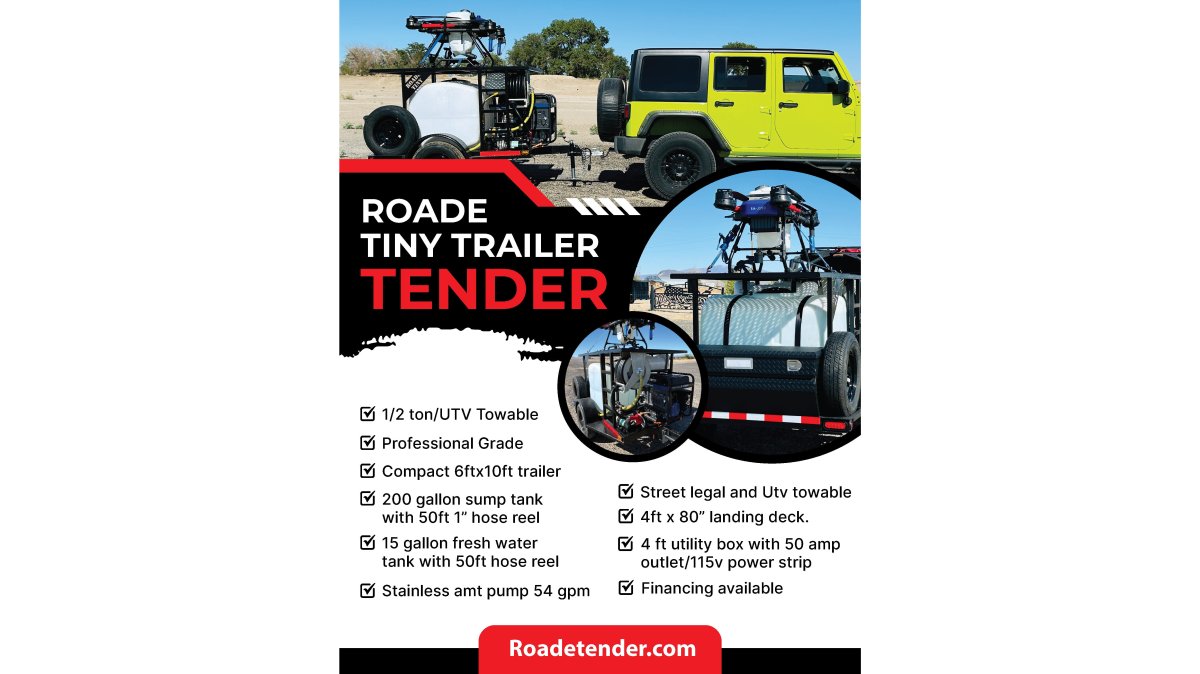
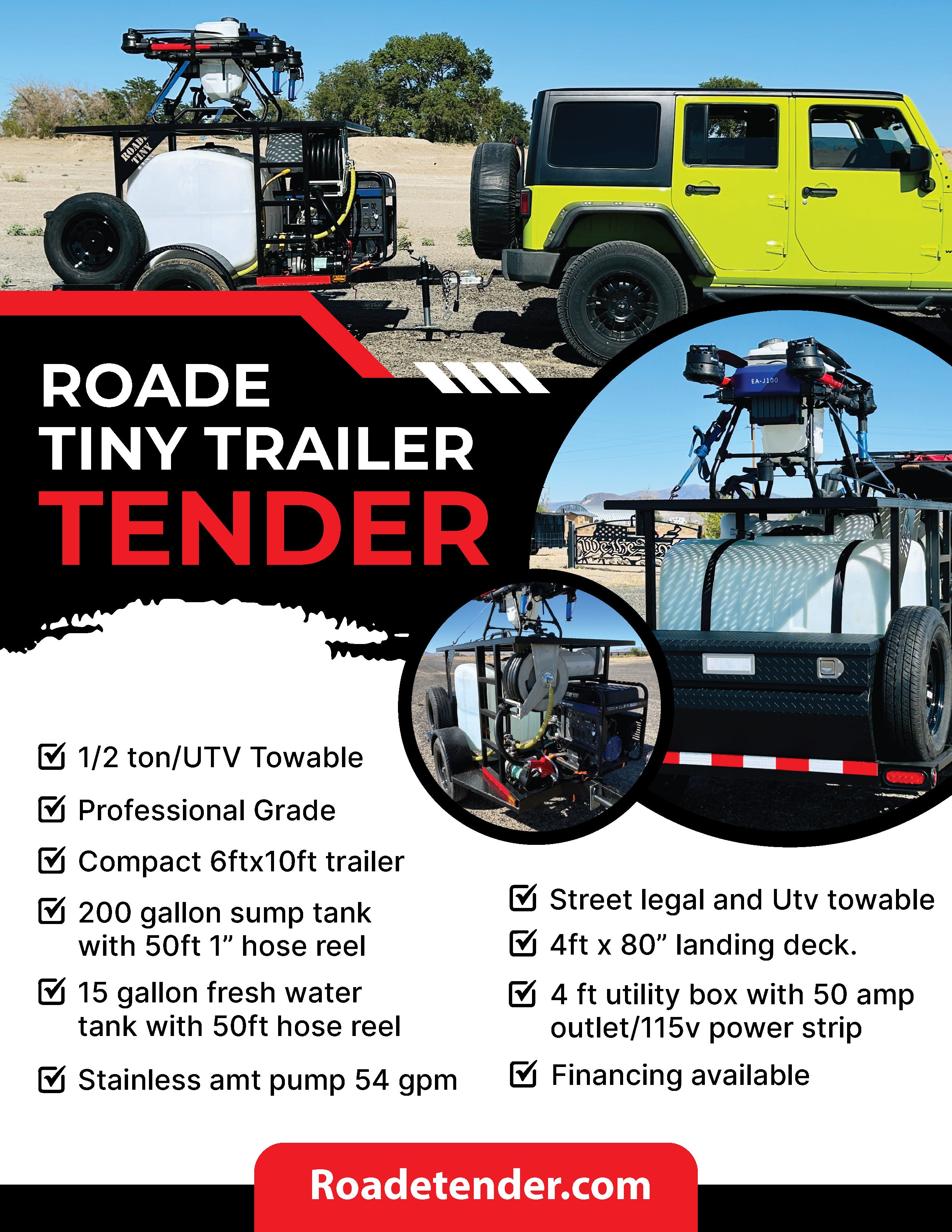
| Roade Tiny trailer | $10,500 | Half-ton trucks and UTVs | Street legal, 200-gallon tank, stainless pump |
Price
The Roade JR runs a 200-gallon tank with a bottom sump, a 54 gpm stainless chemical pump, and a 5.5 gpm fresh water pump for cleaning. The Roade Tiny trailer fits half-ton trucks and SUVs and stays street legal. To compare the full range, browse the Roade Tenders collection. Ready to spec one for your fleet? Contact our team for a quote.
Refill time is the one number most operators never track, and it is the one that quietly caps their daily output. Measure it, fix the bottleneck, and match your tender to your fleet.
Frequently Asked Questions
How long does it take to refill an agricultural spray drone?
A manual refill with jugs and a hand pump takes longer per cycle than a dedicated transfer pump. A tender with a 200-gallon tank and a 54 gpm chemical pump lets the operator skip hauling containers, and the time saved adds up over a full day of cycles.
What pump is best for filling an agricultural spray drone?
Look for a self-priming transfer pump rated for chemical service, not a freshwater pump. Stainless or chemical-rated wetted parts matter because spray solutions are corrosive. Match flow rate to your tank size and your target fill time. Also confirm the pump handles the viscosity of your mix.
How do I reduce downtime between agricultural drone spray flights?
Run refills and battery changes in parallel instead of in sequence. Park the tender at the downwind edge of the field, stage charged batteries on a remote-outlet storage box, and have the next mix ready before the drone lands. Measuring your refill time per cycle is a practical first step to find the bottleneck.
What equipment do I need for a spray drone refill station?
At minimum: a water source tank, a chemical mixing tank, a transfer pump with hose and reel, a rinse tank for cleaning, and a power source for the pump and battery chargers. A tender like the Roade JR adds a 200-gallon tank with bottom sump, a 54 gpm stainless chemical pump, a 25-gallon freshwater tank, and remote-controlled outlets in one unit. The Roade jr DIY Kit at $4,500.00 covers the frame, sump tank, and rinse tank if you already have a generator.
