
How Do Agricultural Spray Drones Work? A Complete Guide
Last Updated: November 22, 2026
Quick Summary
Agricultural spray drones work by carrying a tank of crop protection product and releasing it as a controlled mist over a field. A pump pushes liquid through nozzles or atomizers, rotor downwash drives droplets into the canopy, and GPS guidance holds the flight path steady.
- Tank capacity on most working ag drones runs roughly 10 to 50 liters depending on airframe class.
- Rotor downwash pushes air downward so droplets reach lower leaves instead of sitting on top.
- Test the pump and nozzles with clean water into a bucket before loading product.
- Add water first, then product, per the label, and mix at the tender or mixing station.
- Refill and swap batteries together so the aircraft is down once, not twice.
Table of Contents
- How Agricultural Spray Drones Work: From Tank to Canopy
- Agricultural Spray Drone Equipment You Need Beyond the Aircraft
- Step-by-Step Operating Workflow: Setup Through Cleanup
- How Many Acres Can an Ag Drone Spray Per Hour?
- Drone Spraying Cost Per Acre: What to Budget
- Drone Spraying Benefits and Challenges
- Regulations, Licensing, and Pesticide-Label Compliance
- Choosing a Tender to Keep Your Fleet Field-Ready
- Frequently Asked Questions
How Agricultural Spray Drones Work: From Tank to Canopy
An agricultural spray drone is an uncrewed aircraft that carries a tank of crop protection product and releases it as a controlled mist over a field. Field support equipment keeps these aircraft running, and the mechanics are worth understanding before you buy or operate one. The short version: a pump pushes liquid from the tank through nozzles or atomizers, rotors create downwash that drives droplets into the canopy, and GPS guidance holds the flight path steady. Below, we walk through how do agricultural spray drones work in practice, from tank fill to final rinse.
The machine is simpler than it looks. Four systems do all the work: the spray system, the flight platform, the guidance system, and the power supply. Each one has to hold up under heat, dust, and repeated cycles.
The Spray System: Tank, Pump, Nozzles, and Atomizers
The spray system is the tank, pump, plumbing, and nozzles working as one unit. Tank capacity on most working ag drones runs in the range of roughly 10 to 50 liters, depending on the airframe class.
The pump moves liquid at a set flow rate. Nozzles or atomizers then break that liquid into droplets of a chosen droplet size. That size drives everything downstream: how far droplets drift, how well they land on the leaf, and how much bounces off.
A common mistake is treating droplet size as a fixed setting. It is not. You change it with nozzle choice, pressure, and spray speed.
Flight Platform, GPS Guidance, and Route Planning
The flight platform is the airframe, rotors, and motors. Rotor downwash pushes air downward, which helps droplets reach lower leaves instead of sitting on top.
GPS guidance and mission planning software hold the aircraft on a set flight path. Route planning sets the spray width and overlap between passes, so you don't leave strips unsprayed.
Terrain following and obstacle avoidance keep the drone at a steady height above uneven ground. On rolling fields, that matters more than raw speed.
Agricultural Spray Drone Equipment You Need Beyond the Aircraft
The aircraft is one line item. The rest of the setup decides whether you actually finish fields on schedule.
Most operators need:
- Extra batteries and a high-output charger
- A water source and mixing station for tank fills
- A transport trailer or tender with tank, pump, and hose
- Spare nozzles, filters, and a rinse kit
- A generator for remote recharging
For a deeper look at what goes into a full field kit, our drone field support equipment guide covers the gear that sits around the aircraft.
Without a tender, you may spend the day driving back to a water source, which is a common time leak for small operations.
Step-by-Step Operating Workflow: Setup Through Cleanup
Here is the workflow we recommend, in order. It is not glamorous, but it prevents most field problems. The sequence matters as much as the individual steps: skipping a preflight check or rinsing late can cost a whole tank of product or a nozzle set.
1. Preflight checks before anything gets wet
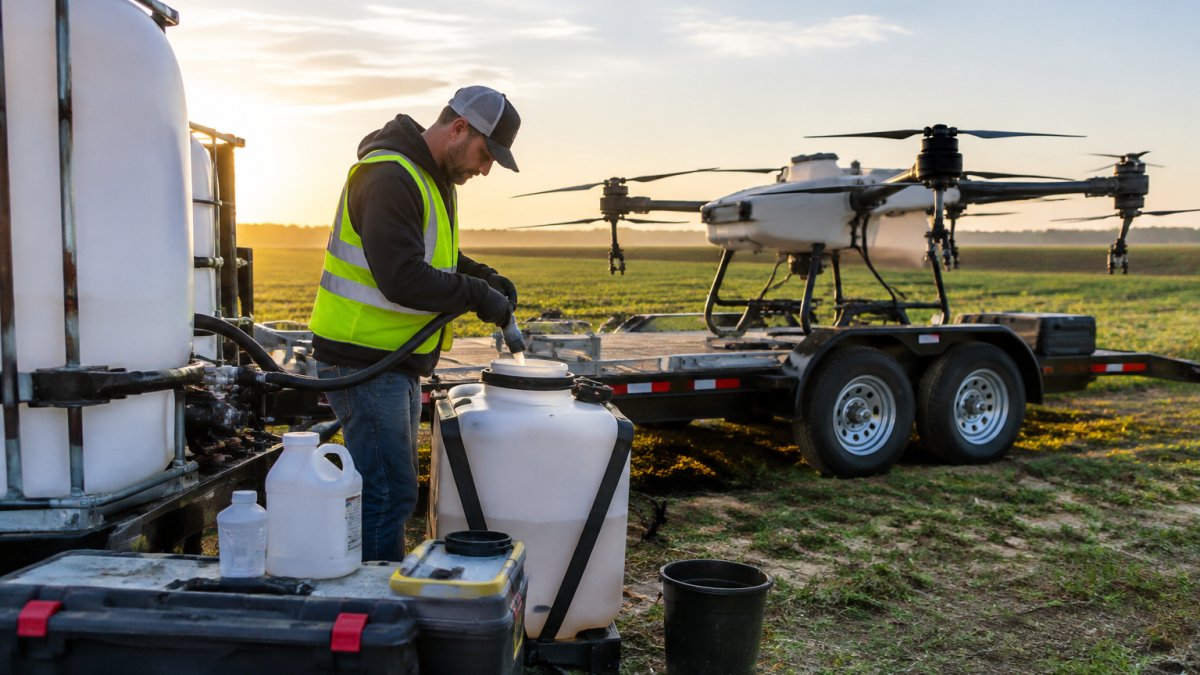
Start with the aircraft powered off. Inspect rotors for nicks and cracks, confirm every blade is snug, and check that the spray tank, pump fittings, and hose connections are seated and free of dried product. Test the pump and nozzles with clean water into a bucket to confirm flow and pattern before you load product. Confirm battery charge level and that the controller, GPS, and obstacle sensors are functioning. Verify the mission boundary and any no-spray zones on the map against the actual field edges.
Watch out: a nozzle partly clogged from the last job will pass a visual check but under-apply a strip, so run the water test every time rather than trusting a glance.
2. Mix the tank in the right order
Add water first, then product, per the label. For most formulations the label specifies a sequence for compatibility agents, adjuvants, and the active ingredient, and adding product to a dry tank can leave concentrate in the plumbing. Mix at the tender or mixing station, not at the field edge, so spills are contained on a pad rather than in the crop. Use a pump and hose to fill the drone, not a bucket, to keep the load measured and the operator clear of splash.
3. Load the mission and confirm parameters
Load the mission and confirm boundaries, spray width, flight height, and application rate on the controller. Check that the spray width matches the nozzle configuration you installed and that overlap between passes is set so no strip is missed. Confirm the terrain-following height clears the tallest part of the canopy and any obstacles inside the boundary.
4. Spray the field
Spray the field while watching flow rate, tank level, and ground speed on the controller. If flow rate drops or the pattern changes, stop and diagnose rather than finishing the pass. Keep the aircraft at the planned height; climbing to clear an obstacle changes the swath and the deposition.
5. Refill and swap batteries as a single stop
Refill and swap batteries together so the aircraft is down once, not twice. For ways to cut that downtime, see our speed up agricultural drone refilling field workflow guide. This is where a good tender pays for itself: a pump, hose, and mixing station at the field edge turn a round trip to a water source into a few minutes. Track how many tanks you have applied against the planned acres so you catch a short or over-application before the field is finished.
6. Rinse and clean before the product dries
Rinse and clean the tank, pump, and nozzles with clean water before the product dries in the lines. Flush until the rinse water runs clear, then run a final clean-water pass through the nozzles. Dispose of rinse water according to the label and local requirements, not on the ground or in a ditch.
7. Postflight checks and logging
After the last tank, inspect the aircraft for product buildup, check nozzles for wear, and note any mechanical issues for the next service. Log the run: acres treated, product used, tank count, weather at start and finish, and any anomalies. That record is what lets you compare actual output against the label rate and spot drift or calibration problems before the next job.
Here is the operating sequence the article recommends, in order.
| Step | What to do | Key detail |
|---|---|---|
| 1. Preflight checks | Inspect rotors, fittings, and sensors before anything gets wet | Test pump and nozzles with clean water into a bucket |
| 2. Mix the tank | Add water first, then product, per the label | Mix at the tender or mixing station, not the field edge |
| 3. Load the mission | Confirm boundaries, spray width, flight height, application rate | Check spray width matches nozzle configuration and overlap |
| 4. Spray the field | Watch flow rate, tank level, and ground speed | Stop and diagnose if flow rate drops or pattern changes |
| 5. Refill and swap batteries | Do both together so the aircraft is down once | Track tanks applied against planned acres |
| 6. Rinse and clean | Flush tank, pump, and nozzles before product dries | Flush until rinse water runs clear, then a clean-water pass |
| 7. Postflight checks and logging | Inspect for buildup and nozzle wear, note mechanical issues | Log acres, product used, tank count, weather, anomalies |
How Many Acres Can an Ag Drone Spray Per Hour?
Acres per hour depend on tank size, spray width, and refill time, and the figure varies by airframe and field conditions.
The number that actually matters is field coverage per day, not per hour. Refill and recharging time often eat more of the day than flying does. A tender that cuts refill time in half can add hours of flight time without changing the aircraft at all.
Drone Spraying Cost Per Acre: What to Budget
Drone spraying cost per acre depends mostly on product cost, labor, and equipment depreciation. Build your own figure from your actual inputs.
Budget these lines:
- Product cost per acre
- Operator labor and travel
- Drone depreciation and maintenance
- Battery replacement over time
- Tender and transport costs
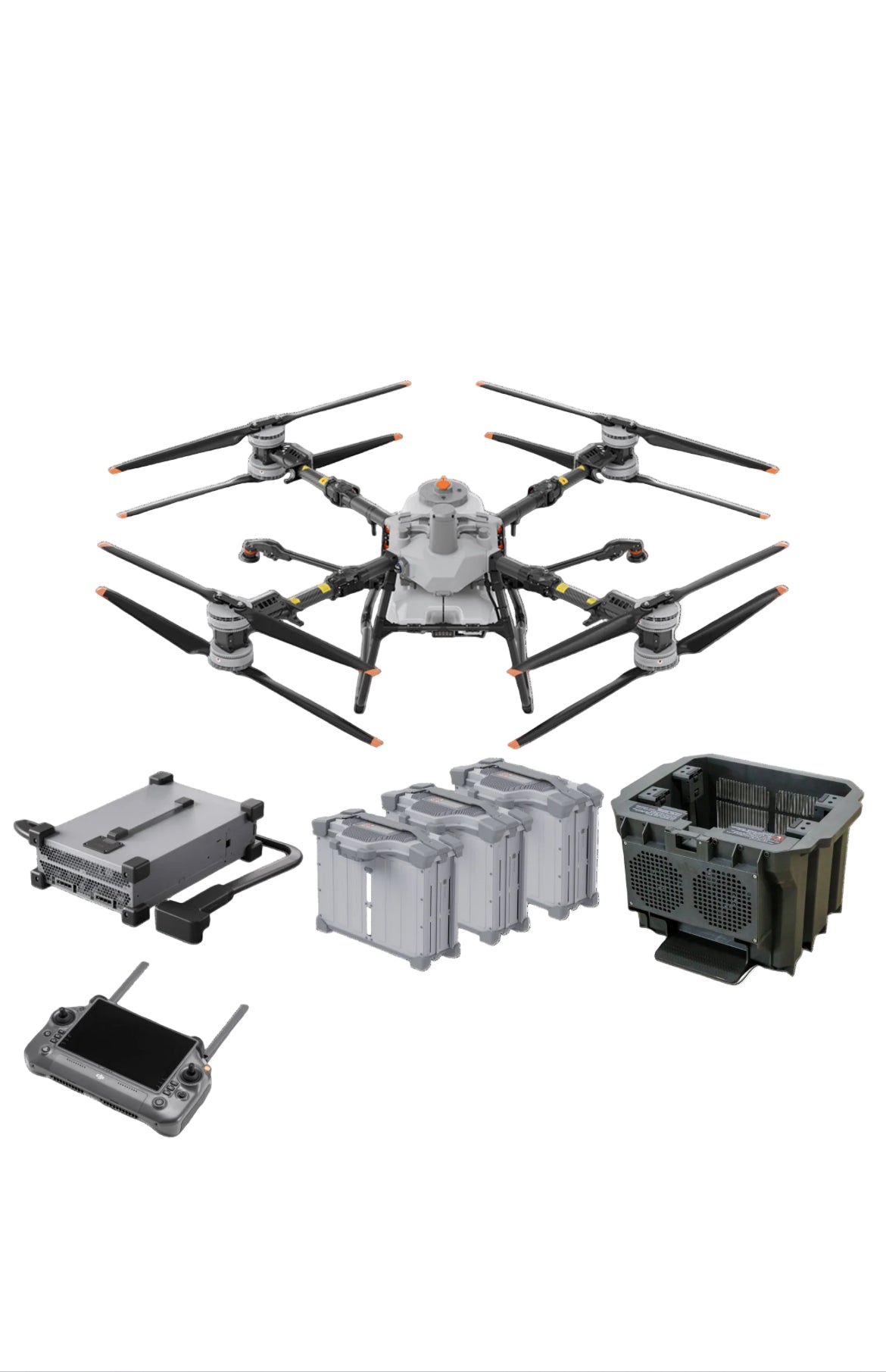
If you are pricing a full setup, our DJI T100 base ready to fly kit lists at $41,500.00 and includes the aircraft, remote controller, three intelligent flight batteries, a C12000 charger, a tool kit, and cables. That gives you a real anchor for the equipment side of the math.
Drone Spraying Benefits and Challenges
The benefits are real. So are the limits.
Benefits:
- Fast coverage of fields that are hard to reach with ground rigs
- Less soil compaction than heavy sprayers
- Precise, targeted spraying with GPS guidance
- Good access to wet fields where tractors would rut
Challenges:
- Small tank capacity means frequent refills
- Battery endurance limits continuous work
- Drift risk in wind
- Regulatory and label compliance work
Weather, Drift, and Droplet-Size Decisions
Drift is the main safety and legal risk in any pesticide application. Wind carries fine droplets off target, and that can mean damage to neighboring crops or a label violation.
Three levers control it:
- Droplet size: larger droplets drift less but cover leaves less evenly
- Wind conditions: spray when wind is low and steady, and watch direction
- Spray height: lower passes reduce exposure to moving air
Check the product label for wind restrictions before every run. The label is the law, not a suggestion.
Regulations, Licensing, and Pesticide-Label Compliance
In the United States, drone spraying falls under federal rules. Confirm current requirements with the relevant federal aviation and pesticide agencies before your first flight.
Beyond aviation rules, the pesticide label governs use (the EPA). It sets the application rate, the required droplet size, wind limits, and buffer zones. Applying off-label is a violation regardless of how well the drone flies.
State-level pesticide applicator requirements may also apply (the EPA). Check with your state lead agency.
Choosing a Tender to Keep Your Fleet Field-Ready
A tender is the piece of equipment that decides your daily throughput. It carries water, product, a pump, a hose, and often a generator and mixing station, so the drone never leaves the field to refill.
Roade Tender builds custom spray drone tenders for DJI, J100, P150 Pro, EA Vision, and XAG systems, offered as ready-to-fly kits and DIY kits. You can browse our spray drone tenders to see the range, or read our breakdown of custom tender setups that keep fleets flying if you are still deciding on a configuration.
Best for: operators running multiple drones who lose hours to refills. Skip if: you fly one small drone on a few acres and refill from a truck tank.
Watch out: buying a tender sized for one airframe and then adding a second drone model mid-season. Confirm fit for every model you plan to run before you order.
Spraying season does not wait for equipment problems. If refills and battery swaps are eating your day, we can help you spec a tender that fits your exact fleet. Roade Tender builds custom tenders with brand-specific mounting, integrated mixing and pump setups, and both ready-to-fly and DIY options. Get started with Roade Tender and cut your field downtime this season.
Frequently Asked Questions
How do agricultural spray drones apply pesticides to crops?
A spray drone carries a tank of mixed pesticide or foliar fertilizer. A pump pushes the liquid through nozzles or atomizers that break it into droplets, and the spinning rotors create downwash that pushes those droplets into the crop canopy. GPS guidance keeps the aircraft on a planned flight path, and the operator sets flow rate and droplet size to match the label rate. The result is targeted spraying that covers the field evenly without ground equipment driving through the crop.
How many acres can an ag drone spray per hour?
A single agricultural spray drone's coverage depends on tank capacity, spray width, battery endurance, and refill time. Larger platforms with bigger tanks and wider spray widths can push toward the higher end, while smaller rigs on uneven terrain run lower. The real limiting factor is often how fast you can refill the tank and swap batteries, which is why a dedicated tender with a generator and mixing station matters for keeping acres per hour high.
How much does drone spraying cost per acre?
Drone spraying cost per acre depends on crop, chemical cost, field size, and travel distance. For operators who own their equipment, the per-acre cost drops to chemical, battery charging, maintenance, and labor. A ready-to-fly kit like the DJI T100 base kit at $41,500 is a capital cost that gets spread across many acres over multiple seasons, so high-acreage operations see a lower cost per acre than small farms.
What equipment does a spray drone need to operate?
Beyond the aircraft itself, a spray drone operation needs a tender or support vehicle with a water tank, mixing station, generator or battery charger, and storage for chemicals and spare parts. You also need a calibrated flow meter, spare nozzles, a weather station or anemometer, and personal protective equipment. A purpose-built tender designed for your drone model, such as Roade Tender's kits for DJI and XAG systems, keeps refills and battery swaps fast so the aircraft spends more time in the air.
